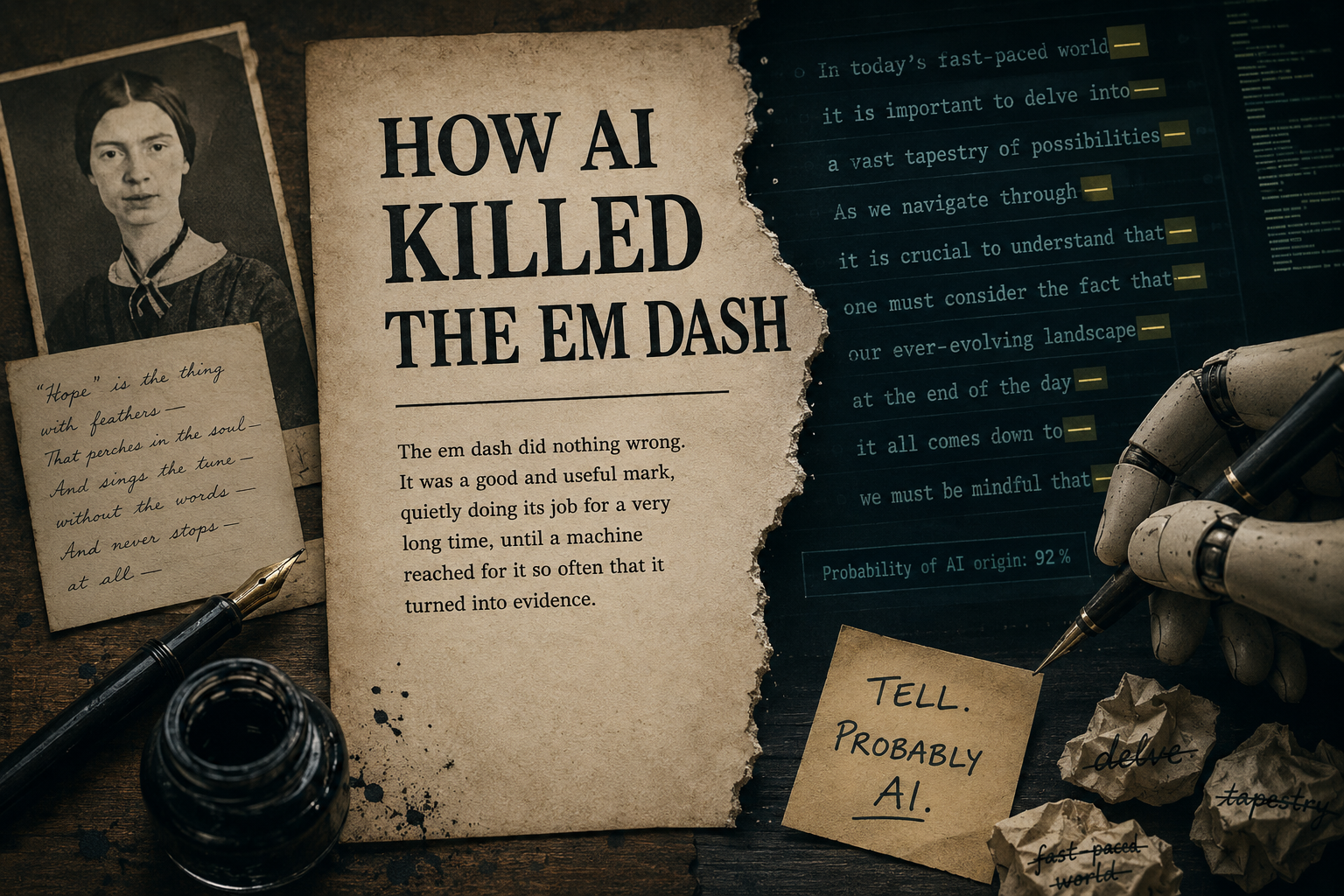
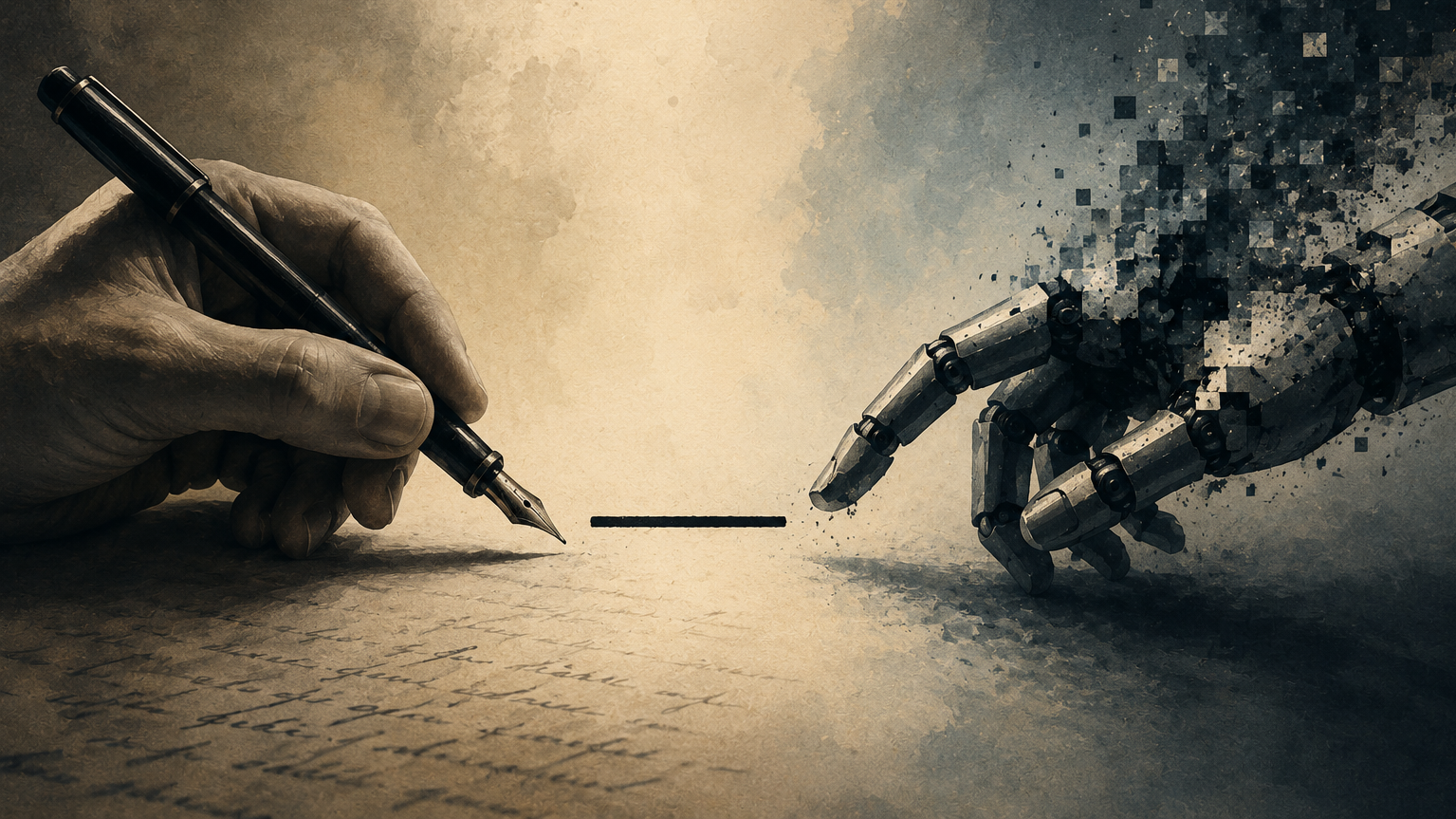
The em dash did nothing wrong. It was a good and useful mark, quietly doing its job for a very long time, until a machine reached for it so often that it turned into evidence.
There was a time, and it was not very long ago, when the em dash meant nothing in particular about who or what had written a sentence. It was simply a good mark, maybe the most expressive one we had. Writers reached for it when a comma felt too quiet and a colon too formal, when they wanted to interrupt themselves mid-thought, or tack on a clause that arrived a beat late, or give a sentence a small catch of breath before its ending. Emily Dickinson built a whole body of work on it. Plenty of careful writers since have leaned on it for rhythm, because it does something the other marks cannot quite manage. It was, in other words, a tool of voice.
Then the language models arrived, and they loved it. Not in any feeling sense, but in the way a system loves whatever sits at the center of its training. The em dash is endlessly flexible, it fits almost anywhere one clause needs to attach to another, and the edited, published prose these models learned from is full of it. So it became a default, the safe and likely choice the model reaches for whenever it needs to join two ideas. Read enough machine-generated text and you begin to feel it, a steady drumbeat of dashes deployed with a smoothness that is almost too even to be a person. The mark that once signaled a particular human cadence started signaling something close to the opposite.
And so, fairly quickly, the em dash became a tell. People who read a great deal online learned to notice it, the same way they learned to notice certain words that seemed to bloom out of nowhere, the sudden delves and tapestries and the sentences that insist on our fast-paced world. A density of em dashes, paired with a certain frictionless rhythm, began to read as probably written by a machine. This is a strange fate for a piece of punctuation. It did not change. It means exactly what it always meant. But the company it now keeps has handed it a connotation it never asked for, and readers respond to that connotation whether or not they could explain why.
The genuinely odd part is what this does to the people who still write by hand, so to speak. A careful writer who happens to love the em dash now faces a small, slightly silly, entirely real dilemma. Use it the way you always have, and risk a reader quietly assuming a machine did the work. Avoid it, and edit a piece of your own voice out of your writing for no reason other than what the mark has come to imply. We are, in small ways, starting to launder our own prose to avoid sounding like the average, trimming the very features the machine happened to adopt. The em dash is only the most visible case. There is a quietly growing list of words and turns of phrase that good writers have begun to avoid, not because any of them were ever bad, but because they have been claimed.
This is where the small story stops being only about punctuation. What the em dash is showing us, in miniature, is that the machine's default voice has become common enough to poison its own markers, and that sounding like a person is slowly turning into something you have to do on purpose. For most of the history of writing, sounding human was the baseline, the thing you got for free simply by being one. That is no longer quite true. When the broad middle of all writing has been flooded with fluent, competent, faintly characterless text, the burden shifts onto the writer to be identifiably not that, to carry enough voice that no one would mistake the work for a system reaching for its safest option. The em dash is just the canary. The real news is that human-sounding writing is becoming a craft you practice rather than a condition you were born into.
We will admit to a small private amusement here, because we banned the em dash from our own writing a while ago, and for none of these reasons. It was taste, mostly, a preference for the rhythm you get from commas and full stops and the occasional colon, along with a suspicion that the dash was doing work our sentences ought to be built to do on their own. It looks like foresight now, but it was really just a house style that happened to age well. What we have come to value is the discipline of the constraint. Take away the easy connector and you are forced to find the structure underneath the sentence, to decide what genuinely belongs together and what deserves to stand on its own. That is good practice whether or not a machine ever touches the keyboard. And yes, in case you were watching for it, there is not a single em dash in this entire piece. We did that on purpose, and it was not even difficult, which is rather the point.