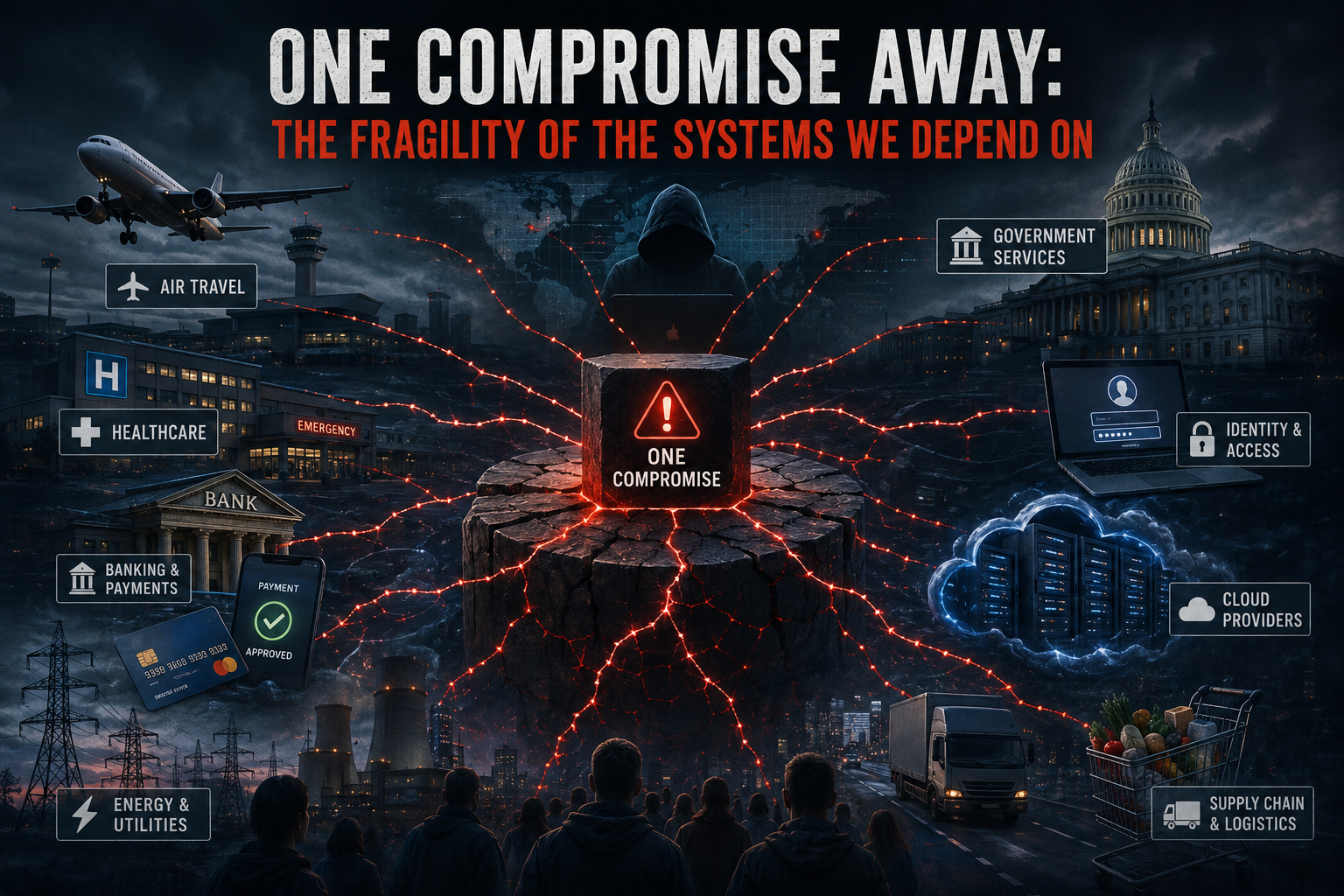

Modern life runs on systems that are more interconnected, more centralized, and more fragile than most of the people who use them realize. The honest question is not whether they will fail, but whether we have done the unglamorous work to keep a single failure from becoming all of them.
Almost nothing about your day is as standalone as it appears. The phone in your hand, the bank that clears the card you tap at lunch, the hospital where your appointment is booked, the government portal you used to renew a license or file your taxes, the air traffic system in the sky above you, the supply chain that put the food on the shelf, the systems your employer logs into in the morning, all of it sits on a layer of software, certificates, name servers, identity providers, cloud regions, and code maintained by people most of us will never meet. It works the overwhelming majority of the time, which is genuinely impressive, and that reliability is exactly what makes it easy to forget how thin the layer underneath is. We tend to confuse "works almost always" with "is robust," and they are not the same thing.
The reminders we keep getting
Every so often the layer becomes briefly visible. A single faulty update to a security product can ground tens of thousands of flights and disrupt hospitals around the world in an afternoon, as we saw in 2024. A backdoor patiently inserted into a small compression utility, maintained essentially by one person, can come within days of slipping into nearly every Linux server on the internet, caught only because one engineer noticed something faintly odd about a benchmark. A ransomware attack on a single healthcare clearinghouse can halt the flow of prescriptions and claims across an entire country. A state-actor compromise of one piece of network management software can quietly open the doors of multiple government agencies, including the United States Treasury, as the SolarWinds operation did in 2020. Another ransomware campaign, this one against an entire national government, was severe enough that Costa Rica formally declared a state of emergency in 2022 while basic services stalled. None of these were edge cases. They were previews. The structural conditions that let each of them happen are still in place and, by most measures, have only sharpened since.
How much modern life actually runs on this
It is worth pausing to name what is actually at stake, because the phrase digital infrastructure badly understates it. The systems we have been describing are how money moves, how people get paid, how taxes are filed and benefits delivered, how prescriptions are written and dispensed, how hospitals know who you are, how flights are scheduled and routed, how the power grid is dispatched, how packages find your door, and how courts, police, and emergency services communicate with each other. There are very few consequential parts of modern life that do not pass through this layer at some point in their day. When we talk about civilization being one compromise away from cascading failure, we are not being colorful. We are describing a society that has, over the last few decades, moved almost every important coordination problem onto a shared substrate, and steadily concentrated that substrate onto a small number of providers, without ever quite admitting that is what we were doing.
The shape of the problem
The reason a single incident can reach so far is not bad luck. It is structural. The world's digital surface runs on a remarkably small and concentrated foundation. A handful of cloud providers host most of the things we use. A handful of content delivery networks sit in front of most of the public internet. A short list of identity providers authenticates a vast share of corporate users. A few package registries and certificate authorities are quietly load-bearing for the entire software ecosystem. The phrase "single point of failure" stops being a metaphor when the thing genuinely is single, and several of the most consequential pieces of our digital infrastructure now meet that description. Compromise or simply break any one of them and the blast radius is not a company or a city. It is global, and it travels at machine speed.
The accelerants
Three forces are pushing this in the wrong direction at once. The first is sheer complexity. Modern software is built by stacking dependencies on top of dependencies, often blindly, with most teams unable to fully account for what they actually import or what would happen if a piece of it went bad. The second is the rate at which AI is now generating new code, much of it shipped without anyone deeply understanding it, which is the security-and-quality failure we describe in How Vibe Coding Is Reshaping Startups playing out at civilization scale rather than at a single company. The third is that hostile actors, including well-resourced nation-state ones, have been quietly getting better, and they too are now using AI. The surface area of catastrophic failure is expanding faster than the discipline of defending it.
Why one compromise can be enough
It is tempting to imagine that a serious incident would require many things to go wrong at once. The reality is that the dependency graph is invisible until it breaks, and once it breaks the failure travels through it instantly. Compromise a widely used package registry and malicious code ships into millions of builds before anyone notices. Compromise a major certificate authority and you can impersonate sites that most browsers trust by default. Compromise a major identity provider and you suddenly have access to every system that authenticates through it, which is most of the corporate world. The XZ utils near-disaster was the clearest recent illustration of the form. A patient, multi-year effort to plant a backdoor in a single piece of nearly invisible plumbing, almost successful, caught largely by accident. We caught that one. We will not catch all of them, and the truthful version of that sentence is the one worth sitting with.
What we usually do wrong
Most of the choices that make us more fragile look completely reasonable at the moment they are made. We optimize for speed and convenience, because both are real virtues and the cost of resilience has to be paid in advance. We treat security as a compliance exercise rather than a discipline, because compliance is what gets audited. We assume failures will be local, since most of the failures we personally encounter look that way up close. We concentrate further onto a few providers because consolidation saves money this quarter, and the systemic exposure that follows does not show up in any one department's budget. Each decision is defensible on its own terms. The aggregate is what is dangerous, and almost nobody is paid to notice the aggregate.
What seriousness looks like
The discipline that addresses this is not exotic, which is partly why it gets neglected. Avoiding monocultures, by running on more than one provider where you reasonably can and accepting the inefficiency, costs short-term margin and buys long-term resilience. Defense in depth, where no single failure cascades, is widely known and unevenly practiced. Real, tested backups, the kind you have actually restored from in a drill, are the only thing that has ever reliably saved an organization from ransomware, and they are exactly the kind of safeguard we argued for at much smaller scale in How to Vibe Code Like a Senior Engineer, where a single AI agent acting without limits managed to delete a production database and its backups in one motion. The lesson is the same at every scale. Most catastrophic failures are caused by missing or unenforced limits, not by exotic attacks, and the boring work of drawing those limits in advance is what separates systems that bend from systems that break.
This is not doom
It would be easy to read this as catastrophism, and it is not meant that way. The point is not that collapse is imminent. The point is that civilization is materially more brittle than its size suggests, and the response that fits the facts is neither despair nor denial. It is the unglamorous discipline that mature engineering has always required. The same way a single careful person is worth more than ten enthusiastic ones in a crisis, a few well-run institutions doing the boring work of resilience are worth more than any number of clever ones that have not.
The conviction underneath it
We write about presence, commerce, and craft on this blog, but we believe what we believe about all of those things because we take the foundations seriously. The reason we favor owning your stack and your data, the reason we keep coming back to the discipline of guardrails and accountability, and the reason we are skeptical of speed when it comes at the cost of understanding, is the same reason any honest engineer is. The systems the world depends on are not as sturdy as they look, and the people who matter most to whether they keep working are the ones doing the patient, unglamorous work nobody ever writes about. That work is the actual product. Everything else, including everything we ourselves do, sits on top of it.