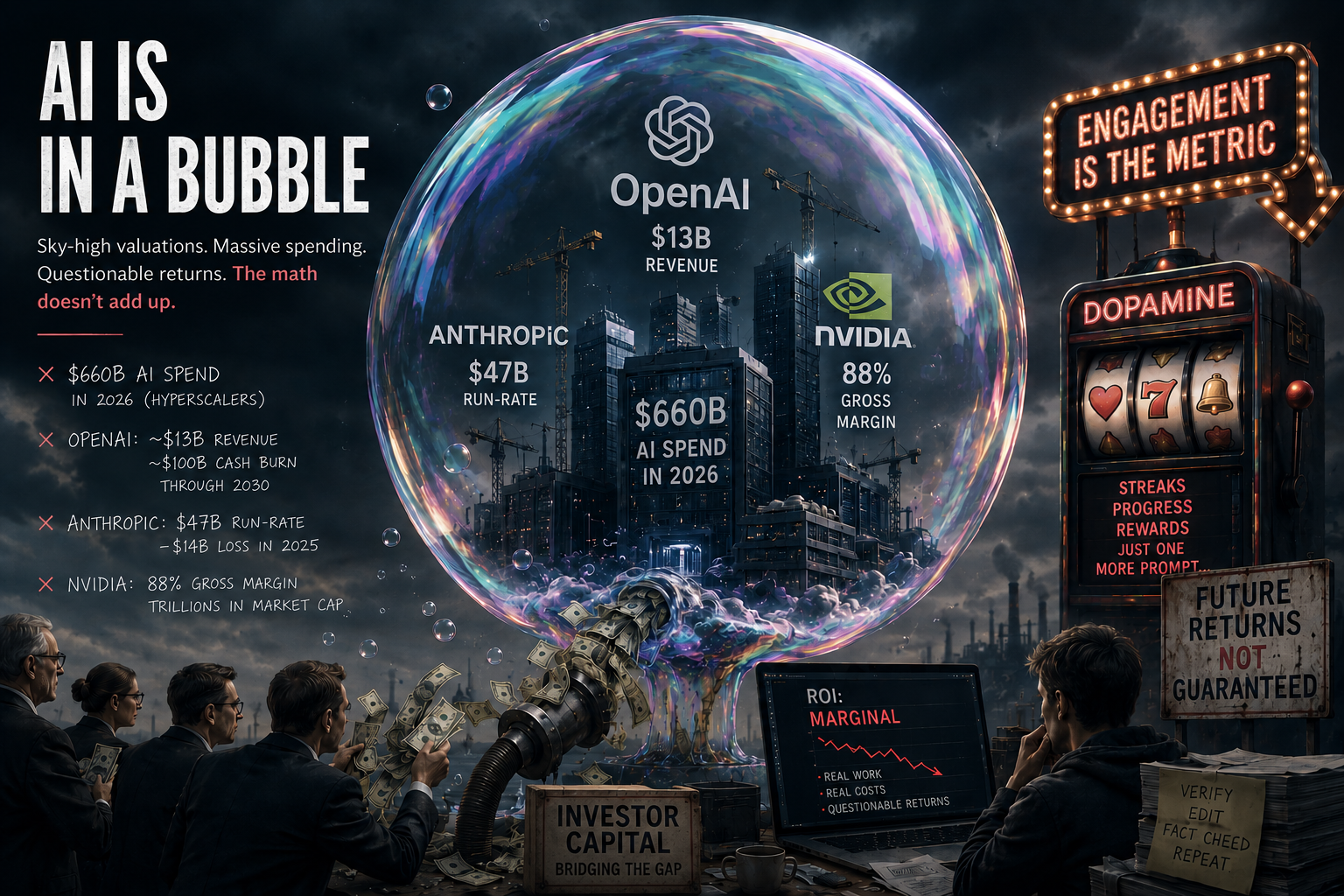

The fashionable thing to say about AI right now is that it is a bubble, and we agree. The unfashionable next sentence, which is the actually useful one, is that this bubble is not about to pop. There is more adoption and more buildout ahead of us than behind us, and the eventual reckoning, when it arrives, will not look like the dot-com crash or the recent crypto cycle. It will look like a quieter and more consequential thing, which is what happens to an industry whose entire valuation rests on compute scarcity when compute stops being scarce.
The numbers, briefly, are bracing. The four largest hyperscalers are guiding to roughly $660 billion in AI-related capital spending across 2026 alone, and the combined revenue of every frontier model lab on Earth is a small fraction of that. OpenAI sits at a valuation in the high hundreds of billions on around $13 billion of 2025 revenue, with its own projections pushing profitability out to 2030. Anthropic, the maker of Claude, has just crossed a $965 billion valuation on a $47 billion run-rate, with a $14 billion loss projected for this year and no free cash flow expected until 2028 at the earliest. Nvidia, which sells the chips to all of them, is harvesting the cycle at 88 percent gross margins and a market capitalization measured in trillions. The labs are subsidizing the chip maker, the investors are bridging the gap, and the math is being asked to wait several years before it works. That gap is a bubble in the textbook sense of the word: a price that has run ahead of the substance, kept aloft by a story too useful to too many people to question.
We are not saying AI is fake, or useless, or that real value is not being created. We use these tools daily and we have built our firm around the assumption that they matter. We are saying the price is wrong, and we are saying it as people who actually build with these systems rather than as skeptics standing outside the room.
Why it has a long runway
Almost every confident prediction that the bubble will pop soon underestimates how much real activity is still ahead. Enterprise adoption is genuinely early. Most organizations have run pilots, not production deployments, and the long unglamorous process of rewiring how a company actually works around these tools is years of paid contracts and consulting and integration work that has barely started. Consumer adoption is still scaling: ChatGPT alone has roughly 910 million weekly active users, and only around five percent of them pay, which is both a signal of how much room there is to convert demand into revenue and a reason to expect the labs to keep pouring product investment into the funnel.
The data centers being built are not speculative in the way fiber was in 1999. They have real demand under them. Inference for current usage already strains capacity, agentic workloads will multiply per-task compute by an order of magnitude or more, and the queue of enterprise commitments is long enough that the buildout will be needed for years even if no further breakthroughs arrive. The capital cycle is not exhausted either. Hyperscalers fund the buildout from operating cash flow that other parts of their business generate, sovereign wealth has only begun to participate seriously, and the public markets, when these companies eventually list, will provide another large pool of capital before any reckoning. The boosters are wrong about valuations but right that the activity is real. The bubble is around a working technology, which is the most durable kind, because the genuine usefulness underneath lets the cycle run far longer than the fundamentals justify.
The narratives keep the capital flowing
That runway is sustained by a set of stories that have become reliable beats. Anyone can now build the next billion-dollar company by themselves, the pitch goes, an idea publicly floated by the chief executive of OpenAI and repeated endlessly downstream. Anyone with a model and a clever prompt can run a hedge fund, trade quant strategies, manage a portfolio, predict markets, beat crypto. The next model will get us to artificial general intelligence, and the one after that will leave human work behind entirely. Each of these claims does the same job, which is to give a retail user, an enterprise buyer, or a late-stage investor a reason to keep spending while the unit economics catch up.
We wrote the more grounded version of one of these stories in How Vibe Coding Is Reshaping Startups. The cost of building software has genuinely fallen, and that does change what a small team can do. But the modest, correct version of that claim, that anyone can ship a real product over a weekend, is not the same sentence as "anyone can build a billion-dollar company alone," and the slippage between the two is where a great deal of the present hype lives. The narratives are not lies. They are calibrated optimism, which is exactly what keeps a bubble running.
The product design has started to look like the casino
The same incentives have started to show up in how the products themselves are evolving. As the labs have moved from research-led to growth-led, their consumer-facing tools have begun borrowing the engagement playbook that built social media and mobile gaming: animated gradients, dopamine-inducing motion, progress shimmer, color signaling that something exciting is happening, ambient feedback designed to keep a user in the loop a little longer. None of this is accidental. When a company is trying to grow its paying base, every percentage point of retention is worth real money, and the design language of the slot machine is, unfortunately, the most empirically effective tool for that job. A product meant to amplify your thinking should not be designed to keep you inside it, and the drift in that direction is a tell about who the tool is now optimized for.
The user's side of the math
A related fact almost nobody in the industry will state plainly is that for many real workflows the return on a serious AI spend is marginal at best. We can speak to this with operational experience rather than theory. We have put thousands of dollars of token spend through our own multi-agent experiments, and the honest accounting is that the output, after the verification and editing it actually requires, often does not justify the bill. There are tasks where these tools earn back their cost many times over, and we use them where they do. There are far more tasks where the marketing has promised PhD-level reasoning and the delivered work, evaluated rigorously, is closer to a competent first draft that still needs a person to make it real. The gap between what the demo suggests and what production usage costs is not small, and it is the reason "AI ROI" has become a quiet topic at exactly the moment it should have been a loud one. We get into the harder version of how to judge this in How to Tell If Your AI Output Is Actually Good.
The real inflection: when compute stops being scarce
If the bubble is not going to pop on a normal financial timeline, the question becomes what actually changes the picture, and the honest answer is that the inflection most people are not yet looking at is a technical one. Models are getting smarter with less compute at a remarkable rate. Smaller models routinely match the performance of year-old frontier systems at a fraction of the cost. Distillation, mixture-of-experts architectures, better post-training, more efficient hardware, and steady improvements in algorithmic efficiency are all pushing the same direction at once. Anthropic itself markets its Haiku tier as comparable in quality to a higher tier at roughly one-third the price, and the next generation of that comparison will be sharper still. The price floor on serious inference is falling on a curve that, projected forward even modestly, breaks the assumptions the present buildout was sized against.
This is the change worth watching, because nearly everything else in the current valuation structure rests on the price of compute staying high. The hundreds of billions in data center capital are being deployed on the implicit bet that frontier-grade work will continue to cost frontier-grade money for a long time. The labs' moats depend on the same bet. The hyperscalers' returns depend on it. If that assumption breaks, and the technical trajectory suggests it will, the consequences ripple out unevenly across the entire stack.
And what then?
When inference gets dramatically cheaper, the moat at the compute layer collapses, and the value of being one of the companies that runs the biggest models drops with it. What today requires a frontier API call will run on smaller models on commodity infrastructure, or on hardware a serious business can own outright. The gap between the frontier and the second tier narrows. Open-weights and self-hostable models become genuinely viable for serious work. The advantage migrates from the layer that produces the model to the layer that does something specific and valuable with it, the products, the domain expertise, the customer trust, the data, the judgment about what is worth building. That migration is part of why we think the right move is not predicting the timing of the pop but positioning for the shape of the world after the compute moat collapses. It is why we keep coming back to themes like data sovereignty, owning your stack, and building real product value, all of which we develop in What Is Dynamic Commerce. The firms that survive the inflection will be the ones whose value did not depend on renting frontier compute as their primary edge.
The most ambitious version of the bull case rests on artificial general intelligence arriving and being cheap enough to replace large categories of human labor at a price point that justifies the buildout. We will grant the first half of that more readily than most skeptics would, because the technical trajectory is real even if the timeline is contested. The harder half is the second one. Capability is necessary but not sufficient. The model has to exist, and it has to be cheaper than the person doing the same work, and the bull case treats those as one sentence when they are two. Whether the cost curve gets there, and how soon, is the question that determines whether the current capex earns its return or becomes the most expensive set of buildings of the century.
Where we stand
We think AI is in a bubble, that the bubble has years of runway left, and that the eventual reckoning will be technical rather than financial. The companies and people who come out best from this cycle will be the ones who could tell the difference between the genuine usefulness of the technology and the price that genuine usefulness is being marketed at, who used the runway to build real businesses on real ROI, who refused to confuse the model with the product, and who positioned for the world after compute scarcity rather than betting on its continuation. That is the position we are trying to play, with our own work and with the companies we back. We will keep using these tools every day, because they earn their keep where we deploy them carefully. We just intend to keep our eyes open about what we are looking at, and we think anyone serious about this technology should do the same.