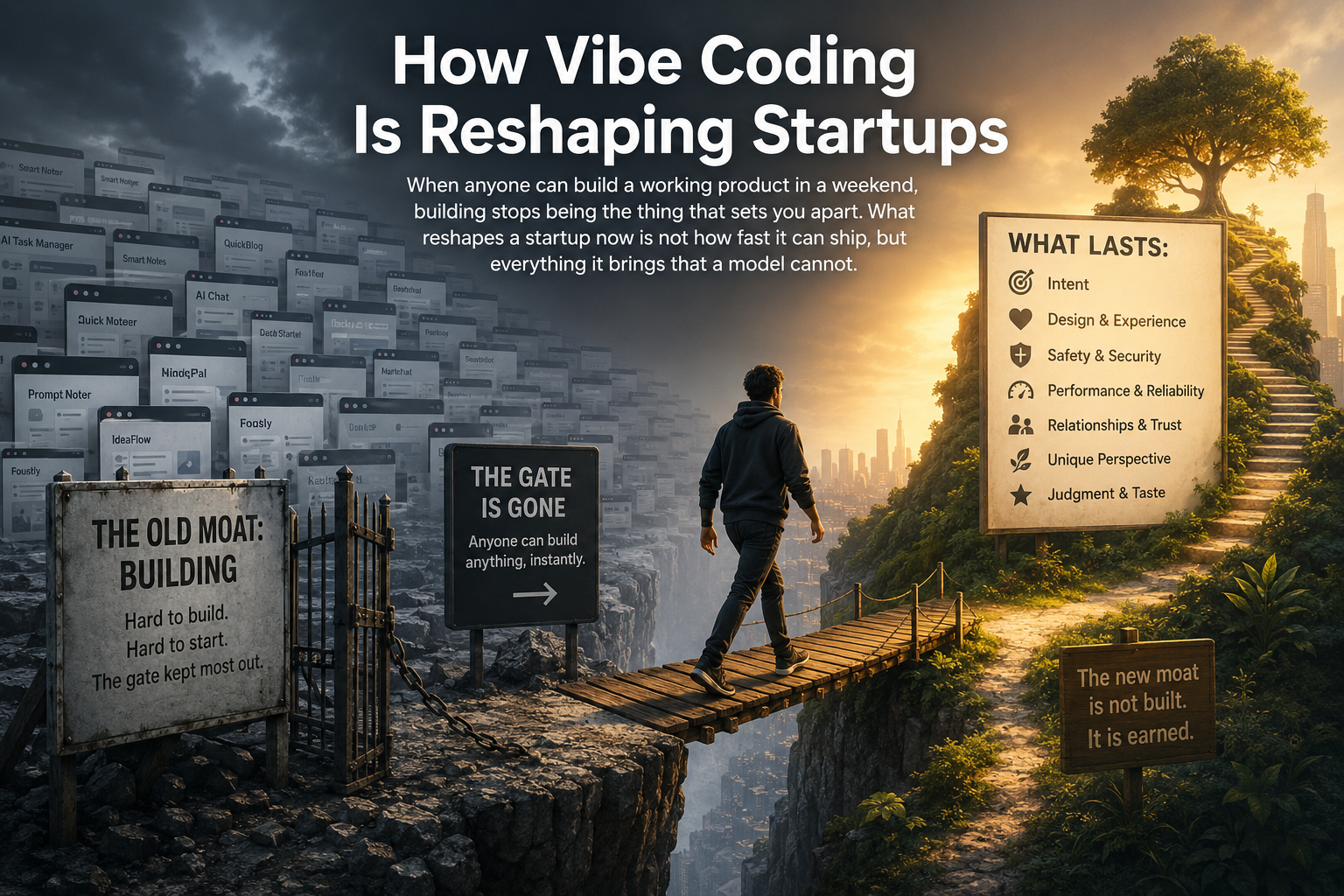

When anyone can build a working product in a weekend, building stops being the thing that sets you apart. What reshapes a startup now is not how fast it can ship, but everything it brings that a model cannot.
Not long ago, getting from an idea to something you could actually show people was the hard part of starting a company. It took a small team, or a founder who could code, and weeks or months of work before there was anything real to react to. The proof of concept was a milestone precisely because reaching it was difficult, and the difficulty did useful work. It separated the people serious enough to build from the far larger number who only talked about building.
Vibe coding has collapsed that distance to almost nothing. A founder can now describe an idea to a capable model and have a working version of it by the end of an afternoon, without writing much code or hiring anyone to. This is genuinely democratizing, and we do not say that with the eye-roll the word usually earns. More people can try more things, and the cost of finding out whether an idea has legs has fallen close to zero. That is good for everyone. But it changes the shape of the whole endeavor in a way that a lot of founders have not fully absorbed, because the thing that got easier was never the thing that actually mattered.
When building stops being the moat
For most of the history of software startups, the ability to build was itself a kind of moat. It was a filter that thinned the field before the competition even began, because capital, technical talent, and time were the gatekeepers, and most ideas died before they ever became products simply because building them was too hard. Founders rarely thought of execution as their edge, but in practice it often was, since so many competitors never made it past the part where you have to actually build the thing.
That gate is gone. And the uncomfortable corollary, the one worth sitting with, is that if you can build your product in a weekend, so can everyone else. The capability that used to distinguish you now distinguishes no one, because it is available to anyone who asks for it. Execution of the build has stopped being scarce, and anything that stops being scarce stops being a source of advantage. The moat did not get smaller. It evaporated.
The question you can no longer avoid
What rushes in to fill that space is the question that always actually mattered, which is whether anyone genuinely wants the thing you made. Product-market fit was always the real test of a startup, but for a long time the sheer effort of building absorbed so much of a founder's attention that it was easy to mistake shipping for progress. You could spend a year heads-down on the build and feel productive the entire time, and the hard verdict about whether the market cared got deferred by all that honest work.
Now you arrive at that verdict almost immediately. This is the genuine gift of the new speed, the chance to put something real in front of people in days and learn the truth fast, and it is also its sharpest edge, because there is nowhere left to hide. The build is no longer evidence of anything. Shipping proves only that you could ship, which everyone can now do, so the founder who built something impressive over the weekend has demonstrated almost nothing about whether they have a business. The work of finding out, the listening, the iterating, the willingness to hear that the thing you made is not the thing people need, is exactly the work the model cannot do for you, and it is now the first real work rather than the last.
What survives the flood
There is a second consequence, and it is the one that reshapes the landscape most. Because the gate is gone, the market fills up. For any given idea there are now hundreds or thousands of products, many of them functional, a great many of them the same average idea executed competently and shipped by someone who described it to a model and pressed go. This is slop at the scale of entire products rather than paragraphs, the kind of thing we describe in What Is AI Slop, and How to Avoid It, and it means a feature is no longer a differentiator, since any feature you ship can be copied into a competitor by the weekend. So the question becomes unavoidable: in a flood of near-identical products, what makes one endure while the rest wash away?
The answer is the set of things a model cannot supply on its own, and they all come back to a person who cared. The first is intent, a real reason for the product to exist and a clear view of who it is for and why it matters, because a model will faithfully build whatever you describe but it cannot decide what is worth building or feel whether it matters to anyone. The second is design, by which we do not mean decoration but the felt experience of using the thing, the hundreds of small judgments about what to include and what to leave out that separate a product that feels considered from one that feels generated. A model produces the average experience by default, and the average is forgettable.
Then there are the qualities that live underneath the surface, where the shortcuts are invisible right up until they are catastrophic. Safety and security are the first casualties of building fast, the unglamorous discipline of protecting people's data, handling the edge cases, and earning the right to be trusted, and they are precisely what gets skipped when a product is generated rather than engineered. Performance is the next, the difference between a demo that dazzles and a product that stays fast and reliable when real people depend on it, which is exactly where hastily generated software tends to fall apart, a danger we get into in How to Vibe Code Like a Senior Engineer. And quality is the sum of all of it, the accumulated care in the details that users feel even when they cannot name it, and that no amount of generation produces by accident.
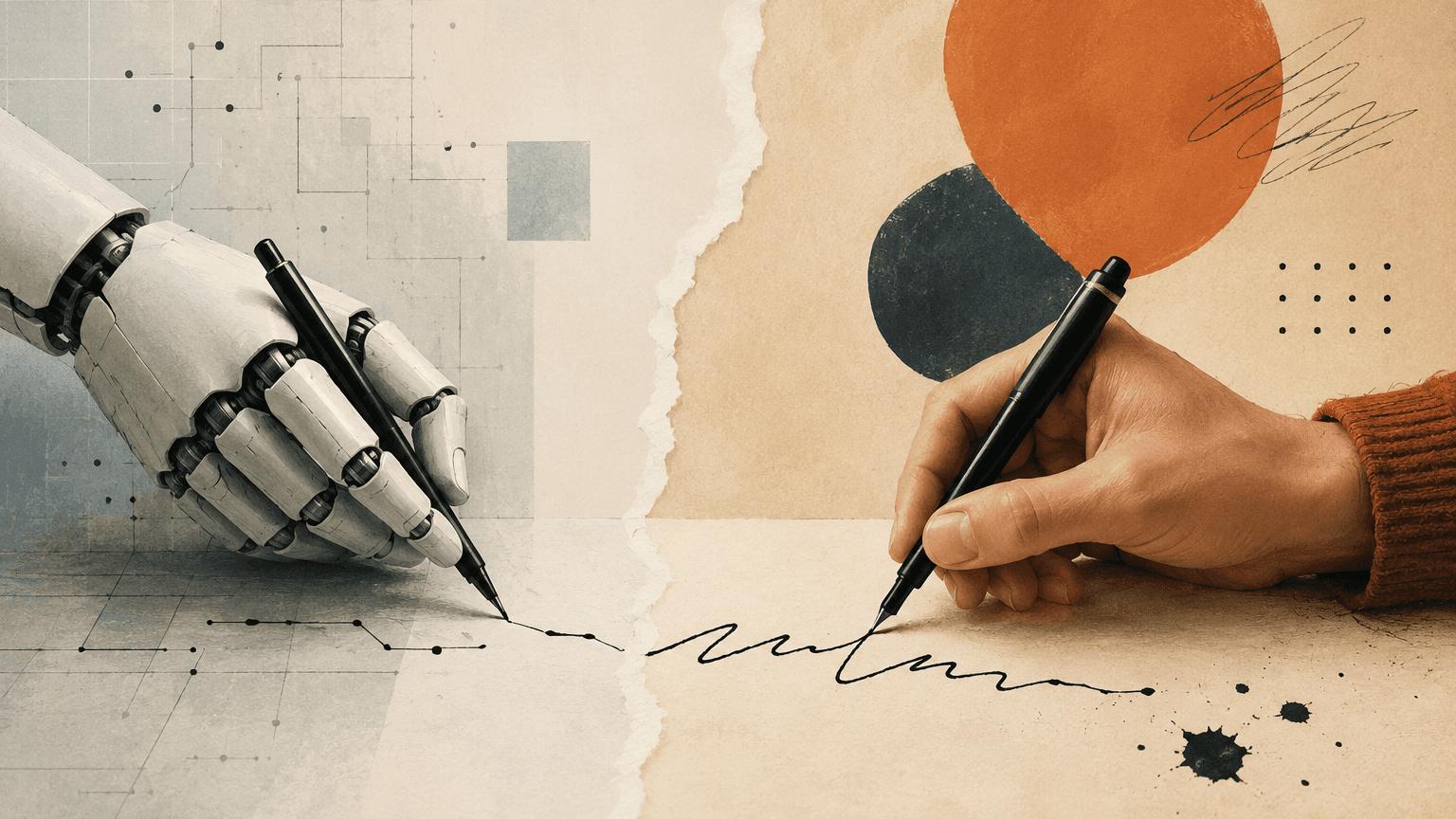
Every one of these is a place where human judgment, taste, and accountability are the actual input. The pattern is the same one we keep returning to in Humans Are the Artist, AI Is the Brush: the better the tool gets at production, the more the human contribution concentrates in the things the tool cannot do, and those things are what people end up trusting and staying with.
The bar moved, it did not drop
So it is a mistake to say vibe coding lowered the bar for startups. It moved it. It lowered the bar to start, dramatically, and in doing so it raised the bar to last. The weekend build now gets you into the game, but it does nothing to keep you there, because everyone else is in the game too. The advantage belongs to the founders who treat the fast build as the beginning of the real work rather than the proof that the work is done, and who bring genuine intent, design, safety, performance, and care to the layers a model will never supply on its own.
This is the conviction underneath how we build and back companies at Esaias and Company. We are glad the cost of starting has fallen, because it means more good ideas get a chance to exist. But we are clear-eyed about what that does to competition, and we are betting, with our own work and the companies we stand behind, that in a world where anyone can build anything, the ones that endure will be the ones where a person cared about every layer a customer can feel.