
The internet is filling with content that is fluent, competent, and completely empty. It has a name now, and learning to avoid producing it is becoming one of the more important things a serious business can get right.
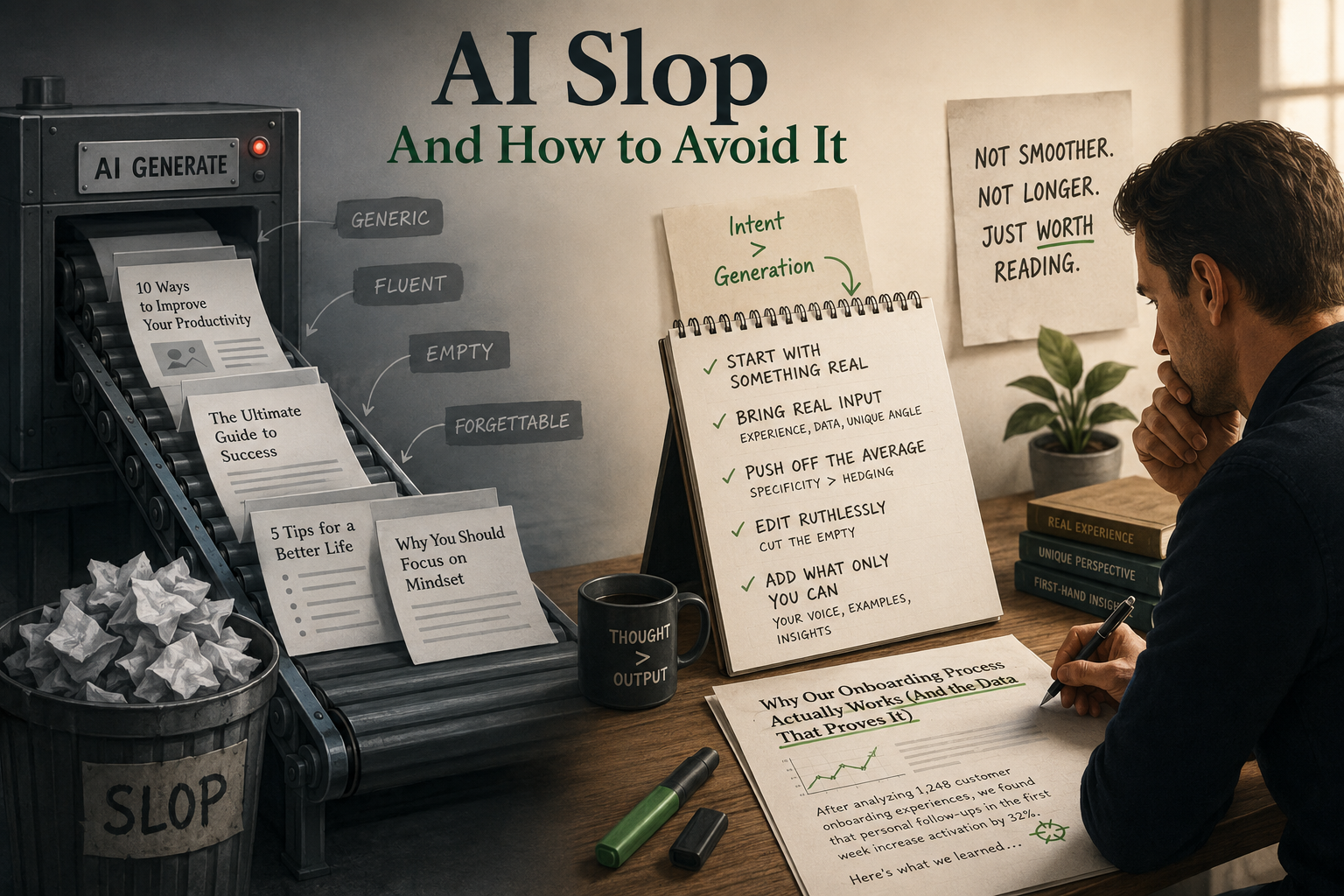
AI slop is low-value content generated by AI and published with little human judgment, intent, or oversight behind it. What makes something slop is not that a machine helped make it, since a great deal of excellent work is AI-assisted, but that generation replaced thought rather than serving it, leaving output that is smooth, generic, and says nothing in particular. You avoid producing it by starting with something real to say, giving the model genuine input, pushing its bland first draft toward specificity, and editing and standing behind the result rather than publishing whatever it hands back.
The short version of the cure: slop is a failure of intent, so the fix is to supply the intent the model cannot.
What slop actually is
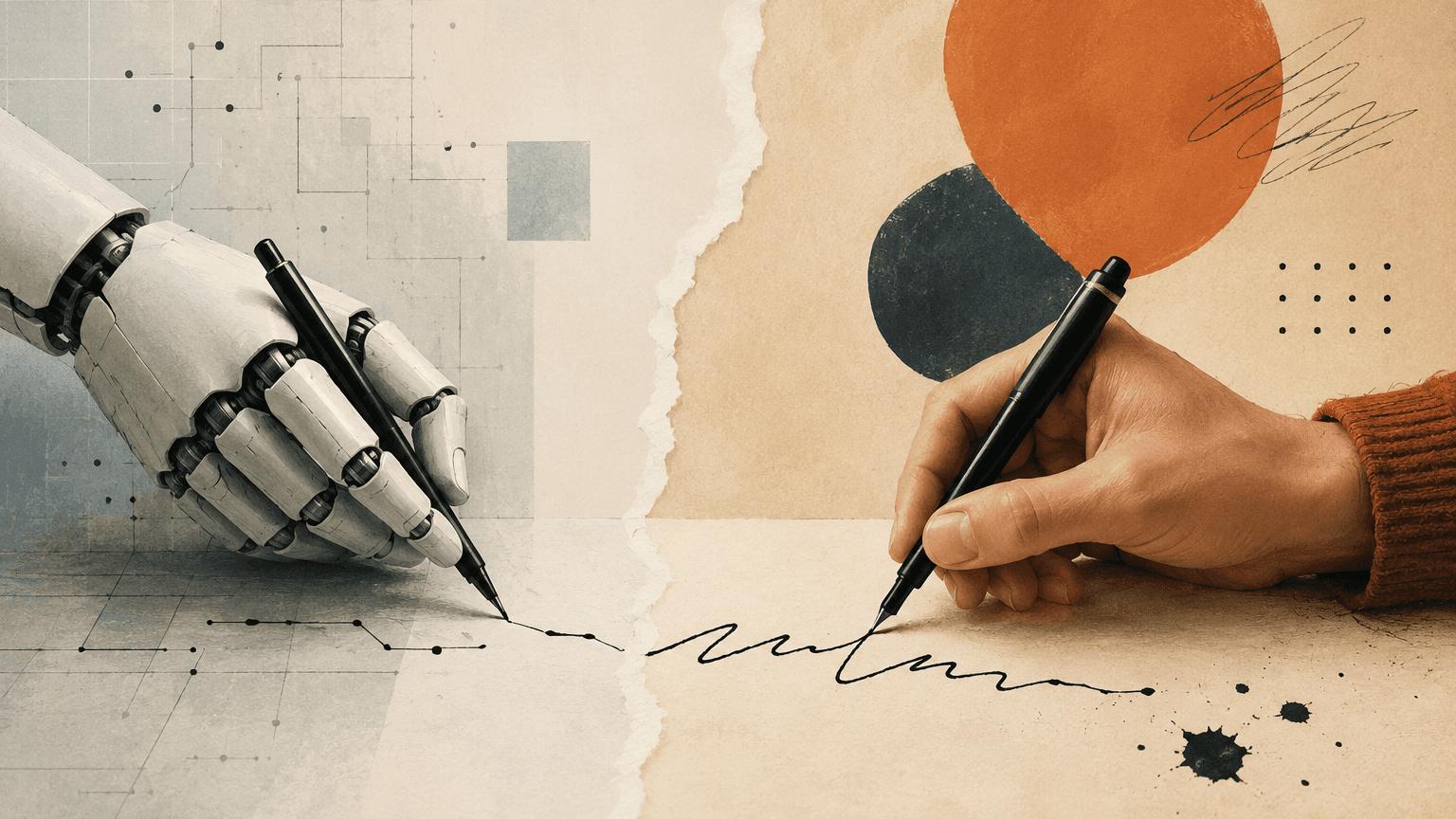
The defining feature of slop is not its origin but its emptiness. It is the absence of a person behind the work, of a point of view, a purpose, or anyone accountable for whether the thing is any good. We made this argument at length in Humans Are the Artist, AI Is the Brush, where the short version is that slop is work with nobody home.
In practical terms, slop is the fluent average. A model, left to its own devices, produces the most statistically likely output for a request, which is competent, agreeable, and characterless, the blended center of everything it has ever seen. That average reads fine sentence by sentence and amounts to nothing as a whole. You have seen it: the blog post that restates the obvious in confident prose, the article that hedges every claim into mush, the social post that arranges pleasant words around a topic without ever landing on a thought. It is not wrong, exactly. It is just hollow, and the hollowness is the whole problem.
It is worth being clear about what slop is not, because the line matters. AI-assisted work is not slop. A piece where a person brought a real argument, gave the model specific input, and shaped and edited the result is simply good work made efficiently. The machine is not the villain here. Abdication is.
Why there is suddenly so much of it
Slop proliferated for a simple structural reason: generation became nearly free, and the volume of content exploded far faster than the judgment to vet it. When producing a thousand words cost real effort, that cost acted as a filter, since nobody wrote much without some reason to. Remove the cost and the filter disappears.
Two forces make it worse. The first is incentive. A great deal of online content exists to feed a quota rather than a reader, the endless churn of posts published to satisfy a search algorithm or an engagement metric, and AI makes that churn trivial to produce at scale. The second is the model's natural pull toward the average we described above. Producing slop is quite literally the path of least resistance, the thing you get by default when you ask for something and accept the first reply. It takes deliberate effort to pull a model off that center, and slop is what happens when no one bothers.
Why slop is worth taking seriously
It would be easy to treat this as an aesthetic complaint, but the stakes are practical. Slop wastes the reader's time and quietly erodes their trust, and people are getting faster at recognizing it, which means publishing it trains your audience to skim past you. For a business the cost is sharper still, because slop signals that you did not care enough to think, and that signal attaches to your name. There is a particular irony for anyone trying to be found by AI, since the systems doing the finding are increasingly weighing genuine quality and authority, and slop is the precise opposite of what gets cited. Flooding your own channels with it actively works against the visibility it was meant to create. And underneath all of it sits a slower problem, a web filling with averageness that future models will learn from, a feedback loop worth refusing to feed.
How to avoid producing it
Avoiding slop is less about technique than about refusing to abdicate. A handful of habits do most of the work.
Start with something to say. Slop begins the moment you generate before you have a point. Decide what you actually want to argue, reveal, or help someone do, and only then bring in the model to help express it. AI is a good instrument for conveying a thought and a poor one for supplying a thought you never had.
Bring real input. Generic in, generic out. The model can only rise above the average if you give it the specifics it cannot know on its own, your experience, your data, your angle, the actual particulars of your situation. This is the same discipline we cover in How to Write a Good Prompt, and it is the single biggest lever on whether output has substance.
Push it off the average. Treat the first response as a starting point, never a finished product. Ask for specificity where it was vague, cut the hedging, demand an actual position instead of a survey of all possible positions. The good material usually lives a few iterations past the default.
Edit ruthlessly and own every line. Cut the throat-clearing introductions, the padding, the empty transitions, the dutiful "in conclusion" that conclude nothing. If you would not put your name behind a sentence, it does not belong in the piece. Slop survives precisely where no one was willing to delete.
Add what only you can. A first-hand example, a real opinion, a number from your own work, a specific that no model could have generated. This is usually the exact difference between content and slop, and it is the part that earns trust and citations alike.
Do not publish what you have not read and verified. Fluent and wrong is its own failure, and we cover judging output in How to Tell If Your AI Output Is Actually Good. Nothing should reach an audience that has not passed under a human eye.
A last principle sits above the rest: volume is not the goal. One piece with a genuine point will do more for you than ten that say nothing, and resisting the temptation to flood the zone is itself a competitive advantage now that everyone else can produce infinite filler.
How to recognize it
The tells are consistent once you know them. Slop is vague where it should be specific, hedged where it should commit, padded with words that carry no weight, and strangely uniform, since it all drifts toward the same fluent middle. It lists the obvious, offers no first-hand detail, takes no real stance, and could have been written about any company by anyone. When you read something and come away unable to say what it actually claimed, you have very likely just read slop.
How we think about it
At Esaias and Company we use these tools constantly, and we treat them as instruments in service of a point of view rather than a replacement for having one. That is the whole distinction. The work that carries our name is meant to say something specific, made by someone who decided what it should say, because the alternative is to add one more hollow thing to a web that already has too many.
Frequently asked questions
What is AI slop? AI slop is low-value content generated by AI and published with little human judgment or intent behind it. It is defined not by being machine-made but by being empty, fluent, generic, and lacking any real point of view or person behind it.
Is all AI-generated content slop? No. Content where a person brought a genuine argument, gave the model specific input, and edited and stood behind the result is simply good work made efficiently. Slop is what results when generation replaces thought rather than serving it.
Why is there so much AI slop now? Because generating content became nearly free, so volume exploded faster than the judgment to vet it, while incentives that reward sheer quantity made the problem worse. Producing slop is the default outcome of accepting a model's first, most average response without shaping it.
Why does AI slop hurt a business? It wastes readers' time and erodes their trust, and it signals that a company did not care enough to think, which attaches to its reputation. It also works against AI visibility, since the systems that cite sources increasingly favor genuine quality, which slop lacks by definition.
How do I stop producing AI slop? Start with a real point to make, give the model specific input it could not otherwise have, push its generic first draft toward specificity, edit out all the padding, add first-hand detail only you can provide, and verify everything before publishing. In short, supply the intent and judgment the model cannot.