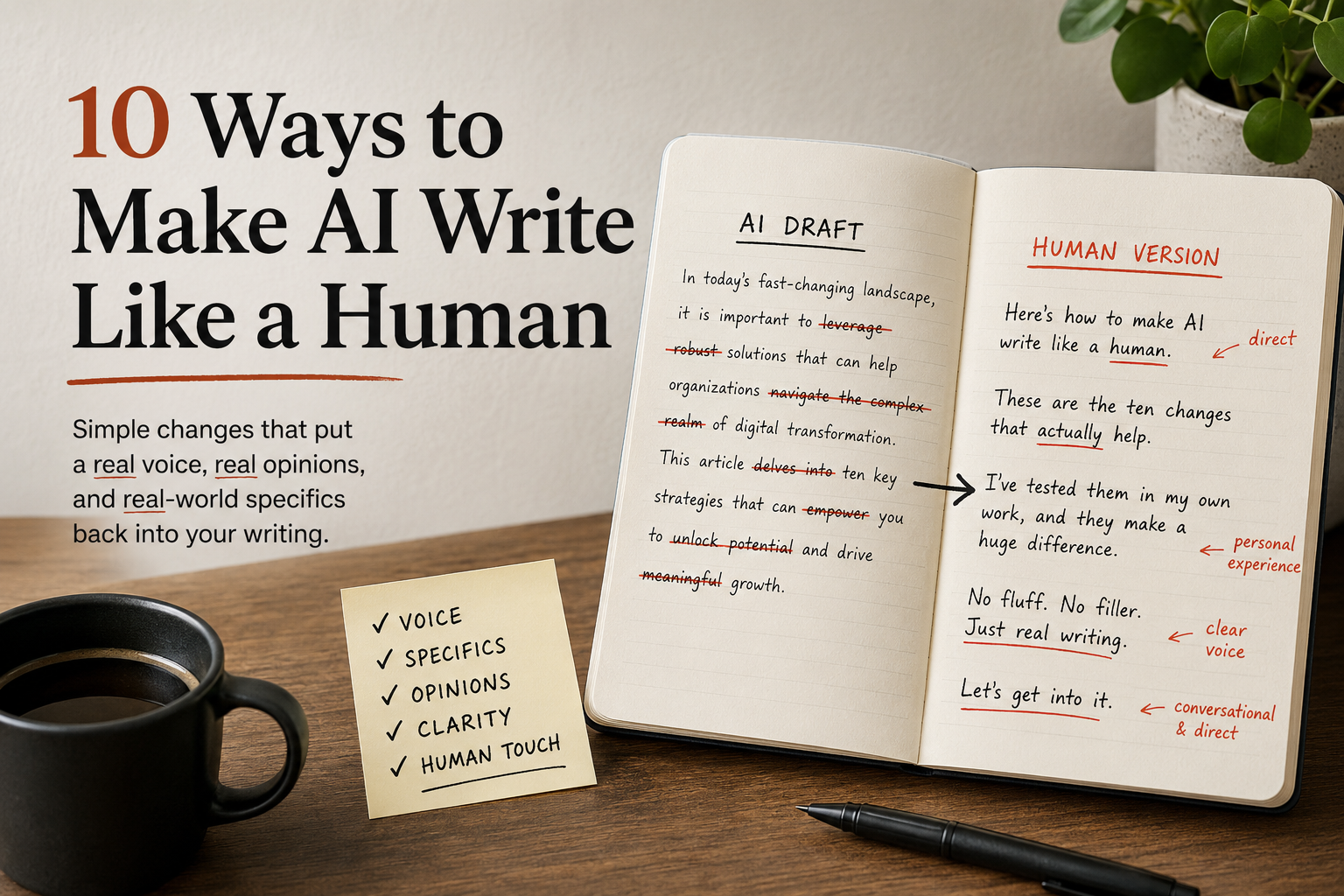
AI writing has a sound. Smooth, balanced, faintly hollow, agreeable to the point of saying nothing. These are the ten changes that do the most to get rid of it, and nearly all of them come down to putting a person back into the work.
The reason AI writing sounds like AI is that, left alone, a model writes toward the average of everything it has read, which is fluent and characterless by default. Making it sound human is the work of pulling it off that average. A couple of the tactics below happen before you generate, in how you prompt. Most happen after, in how you edit. All of them assume the thing worth protecting is a real voice with something to say, which is the larger argument in What Is AI Slop, and How to Avoid It.
1. Feed it your actual voice
A model cannot imitate a voice it has never seen, so give it yours. Paste in a few samples of writing you are proud of, or describe your style in concrete terms, short sentences, dry humor, no jargon, and ask it to match that rather than write in general. The difference between "write a post about X" and "write a post about X in the voice of these three samples" is the difference between the average and you.
2. Break the rhythm
This is the single biggest tell. A model defaults to sentences of roughly the same medium length, one after another, until the paragraph turns into a steady hum that the ear reads as machine. Human writing moves differently. It runs long and winding when an idea needs room, and then it stops short. Vary your lengths on purpose. One abrupt sentence after three flowing ones does more to humanize a paragraph than any amount of clever word choice.
3. Cut the hedging
Models soften almost everything, burying claims under qualifiers like "it is worth noting," "generally," "in many cases," and "can often." The result reads as though no one is willing to commit to anything. Go through and delete the qualifiers, then let the claims stand on their own. A sentence that says "this works" is human. A sentence that says "this can, in many cases, tend to work" is a machine covering its bases.
4. Delete the throat-clearing
AI loves a warm-up. It opens with a sweeping line about how, in today's fast-changing world, something is more important than ever, and it closes by dutifully restating what it just said. Both are filler. Cut the introduction down to the first genuinely interesting sentence, and end on the last real point rather than a summary. Readers do not need to be eased in and walked out. They need you to start.
5. Retire the tell-tale words and marks
Certain words now function as a signature of unedited AI: delve, tapestry, boasts, robust, leverage used as a verb, navigate the landscape, realm, testament to. Find them and replace them with plain language a person would actually choose. The same goes for punctuation, which is how the em dash quietly became a marker of machine writing, a story we tell in How AI Killed the Em Dash. You will notice there is not one in this article either. That was deliberate.
6. Break the rule of three
Models reach compulsively for triads, the clear, concise, and compelling phrasings that arrive in tidy threes no matter the subject. One or two of these is fine. A page full of them is a fingerprint. Vary your structure. Use a single strong word where the model offered three weak ones, or let a list run to four, or stop at two. The goal is to sound like you chose the words, not like you filled a pattern.
7. Take an actual position
The most reliably robotic move in AI writing is presenting both sides of something and committing to neither, the balanced "on one hand, on the other" that resolves into nothing. People who know their subject have opinions. Decide what you actually think and say it plainly, then defend it. A clear stance, even one a reader disagrees with, reads as a human mind at work. Polished neutrality reads as a model avoiding risk.
8. Add the specifics only you have
Generic writing is the natural output of a generic prompt, and specificity is the fastest cure. Replace the vague claim with a concrete example, a real number from your own work, a name, a moment that actually happened. A model can generate plausible generalities forever, but it cannot invent your particular experience, which is exactly why that detail is the most human thing on the page. This is also what earns trust and citations, a point we make in What Is AI Slop, and How to Avoid It.
9. Loosen the polish
AI writing is often too clean, formal in a way that no real person sustains. Loosen it toward how a thoughtful person actually talks. Use contractions. Start a sentence with "And" or "But" when it earns the emphasis. Let an occasional fragment land hard. The point is not to be sloppy, and you should calibrate this to your setting, since a law firm and a streetwear brand loosen to different places. But a little natural texture beats a flawless surface that feels like a brochure.
10. Read it aloud and cut what you would never say
The ear catches what the eye skims past. Read the draft out loud, and every time you hit a phrase you would never actually speak, the sentence that sounds like a press release, the word you have never once used in conversation, stop and rewrite it in language you would. This single pass removes more residual machine-feel than almost anything else, because the gap between how AI writes and how people talk is precisely the gap you are trying to close.
A note on what this is really about
None of these are tricks for disguising AI writing as human, and that is the point worth being clear about. They are ways of making sure a human was actually involved, that someone supplied a voice, a position, and a specific, and edited the result with care. Do that, and it does not matter that a model helped. The work sounds human because, in the way that counts, a human made it.
A prompt you can use
If you would rather not apply all of this by hand every time, here is a prompt that bakes most of it in. Paste your draft into the tagged section at the bottom and run it. It uses the tagged structure we recommend in How to Write a Good Prompt, since a set of rules like this is exactly the kind of complex instruction those tags handle well.
<role>You are a sharp editor with an ear for natural human prose. You make writingsound like a specific, thoughtful person wrote it, not like a general-purposeassistant.</role><task>Rewrite the text in <draft> so it reads as genuinely human. Preserve themeaning, the facts, and the intent. Change only the voice, rhythm, andphrasing. Return only the rewritten text, with no commentary.</task><rules> <rule>Write in flowing, well-constructed paragraphs. Do not use bullet points, numbered lists, headers, or any deck-style formatting unless I explicitly ask for it.</rule> <rule>Vary sentence length on purpose. Mix long, developed sentences with short ones, and avoid a steady, uniform rhythm.</rule> <rule>Do not use em dashes anywhere. Use commas, periods, colons, or parentheses instead.</rule> <rule>Do not write punchy one-line zingers or dramatic one-sentence paragraphs. Let each idea develop across the paragraph rather than landing like a mic drop.</rule> <rule>Avoid cute wordplay, puns, and double meanings. Favor plain, direct phrasing.</rule> <rule>Cut hedging and qualifiers. State claims plainly and commit to them.</rule> <rule>Do not open with throat-clearing or a windup, and do not close by restating what you just said. Start at the first real point and end on the last one.</rule> <rule>Avoid clichéd AI vocabulary, including delve, tapestry, boasts, robust, leverage as a verb, realm, testament to, and navigate the landscape.</rule> <rule>Do not pile up three-part phrases. Vary the structure so it never settles into a pattern.</rule> <rule>Be specific. Prefer concrete detail over generality, and never pad with filler to reach a length.</rule> <rule>Use natural cadence. Contractions are fine, and you may begin a sentence with And or But when it earns the emphasis. Stay clean, not sloppy.</rule> <rule>Take a clear position rather than presenting every side and committing to none.</rule> <rule>Before finishing, reread and remove any phrase a real person would not say out loud.</rule></rules><draft>[paste your text here]</draft>
Two ways to get more out of it. To write something new instead of fixing existing text, replace the draft section with a short description of what you want and the topic. And for the single biggest improvement, add a sample of your own writing for the model to match, which is the first and most powerful of the ten ways above.
Frequently asked questions
Why does AI writing sound robotic? Because a model writes toward the statistical average of everything it has read, which is fluent but characterless. The robotic feel comes from uniform sentence rhythm, heavy hedging, filler introductions, repeated word patterns, and an avoidance of any real stance, all of which are the marks of that average.
Can you prompt AI to write like a human? Partly. Giving the model samples of your voice and clear instructions about style and what to avoid helps a great deal, but the most human results still come from editing afterward, where you cut the hedging and filler, vary the rhythm, and add the specifics only you can provide.
What words give away AI writing? Common tells include delve, tapestry, boasts, robust, leverage as a verb, realm, testament to, and openers about today's fast-changing world. Overuse of tidy three-part phrases and heavy reliance on the em dash are also frequent signals of unedited AI text.