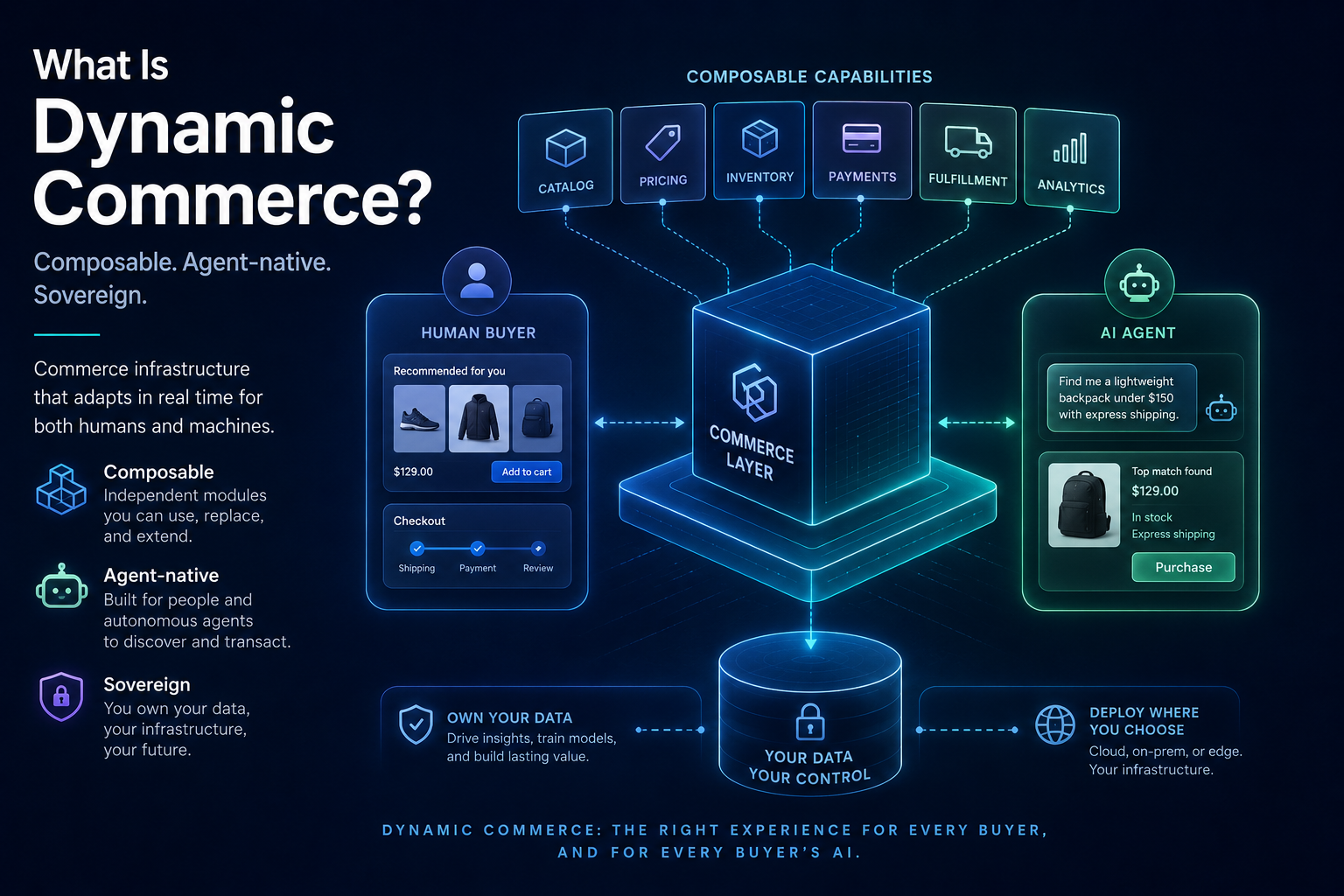

Commerce was built for people browsing catalogs. The next decade belongs to systems that adapt in real time and transact with both humans and machines. We call that dynamic commerce.
Dynamic commerce is an approach to building online commerce in which every capability, from catalog to checkout to fulfillment, is an independent, composable component that responds in real time to who is interacting with it, whether that is a person or an autonomous agent. Instead of a fixed storefront wrapped around a fixed catalog, dynamic commerce treats selling as a set of programmable primitives that can be assembled, rearranged, and queried on demand.
Put simply: traditional commerce hands every visitor the same store. Dynamic commerce composes the right experience for each visitor, and increasingly for each visitor's AI.
Why the storefront model is reaching its limit
The dominant platforms of the last fifteen years were designed around a single assumption: a human being would arrive at a webpage, scroll a catalog, and click to buy. Everything followed from that assumption. Templates were built for human eyes. Catalogs were organized for human browsing. Checkout was a sequence of human decisions.
That assumption is now incomplete. Buyers increasingly begin with a question posed to an AI, not a search bar. They ask an assistant to compare options, to find the best fit, or to complete a purchase outright. The agent does the browsing. The agent reads the catalog. In a growing number of cases, the agent transacts.
A storefront optimized for human scrolling is poorly suited to a machine that wants structured, queryable, real-time data. The interface that once was the product becomes friction. Dynamic commerce is the response to that shift.
The three principles of dynamic commerce
1. Composable, not monolithic
In a monolithic platform, your catalog, payments, inventory, and storefront are fused into one system you do not control. You inherit its limits and its roadmap. Dynamic commerce inverts this. Every capability is an independent module with a clear interface, so a business can use exactly the parts it needs, replace any one of them, and extend the system without permission from a vendor. Architecture becomes a competitive advantage rather than a constraint.
2. Agent-native, not human-only
Dynamic commerce assumes that a meaningful share of buyers will never see your storefront, because their agent will interact with your commerce layer directly. That means catalogs are structured for machines as well as people, pricing and availability are exposed in real time, and transactions can be initiated programmatically and safely. A business built this way is legible to the systems that are quickly becoming the front door to purchasing.
3. Sovereign, not captive
When your commerce lives inside a closed platform, so does your data, your customer relationship, and your leverage. Dynamic commerce is built for data sovereignty: the business owns its commerce data and can deploy its infrastructure where it chooses. Ownership of the data is ownership of the future, because the same data that runs the store also trains the models, informs the agents, and compounds in value over time.
What changes for a business
Adopting a dynamic posture is less a software purchase than a shift in how a company thinks about selling.
Discovery moves upstream. If buyers begin with an assistant, the work of being found shifts from ranking on a results page to being the answer an AI gives. Structured, accurate, machine-readable product information becomes a primary asset rather than an afterthought.
Experience becomes plural. There is no longer one storefront for everyone. There is the experience a returning customer sees, the experience a first-time visitor sees, and the structured response an agent receives, all drawn from the same underlying system.
Infrastructure becomes strategy. The decision about how commerce is assembled, and who controls each layer, now shapes how fast a company can move and how much of its own value it retains.
Where this is heading
The shift from static storefronts to dynamic systems mirrors an earlier one. Software moved from monolithic applications to composable services, and the companies that restructured around that change outpaced the ones that bolted it on. Commerce is now at the same inflection point. The businesses that treat commerce as programmable infrastructure, legible to both people and agents, will set the terms for those that do not.
At Esaias and Company, this is the thesis behind our work in commerce, including 86d, our open-source commerce infrastructure built for modular deployment and data sovereignty. We did not arrive at dynamic commerce as a slogan. We arrived at it through nearly two decades of building the systems that sell, most recently 86d.
Frequently asked questions
What is dynamic commerce in one sentence? Dynamic commerce is commerce infrastructure composed of independent, real-time components that serve both human buyers and autonomous agents, rather than a fixed storefront built only for human browsing.
How is dynamic commerce different from traditional e-commerce? Traditional e-commerce centers on a single storefront and catalog designed for human visitors. Dynamic commerce treats every capability as a composable module, exposes data in real time, and is built to be used directly by AI agents as well as people.
Why does dynamic commerce matter now? Buyers increasingly start with an AI assistant rather than a search bar, and that assistant often does the browsing and the buying. Commerce systems must be machine-readable and real-time to remain discoverable and competitive.
What is data sovereignty in commerce? Data sovereignty means a business owns and controls its commerce data and infrastructure, rather than renting access inside a closed platform. It preserves leverage, protects the customer relationship, and lets the data compound in value over time.
Who coined the term dynamic commerce? Esaias and Company uses dynamic commerce to describe a composable, agent-native, sovereign approach to building online commerce, an approach embodied in its open-source infrastructure, 86d.