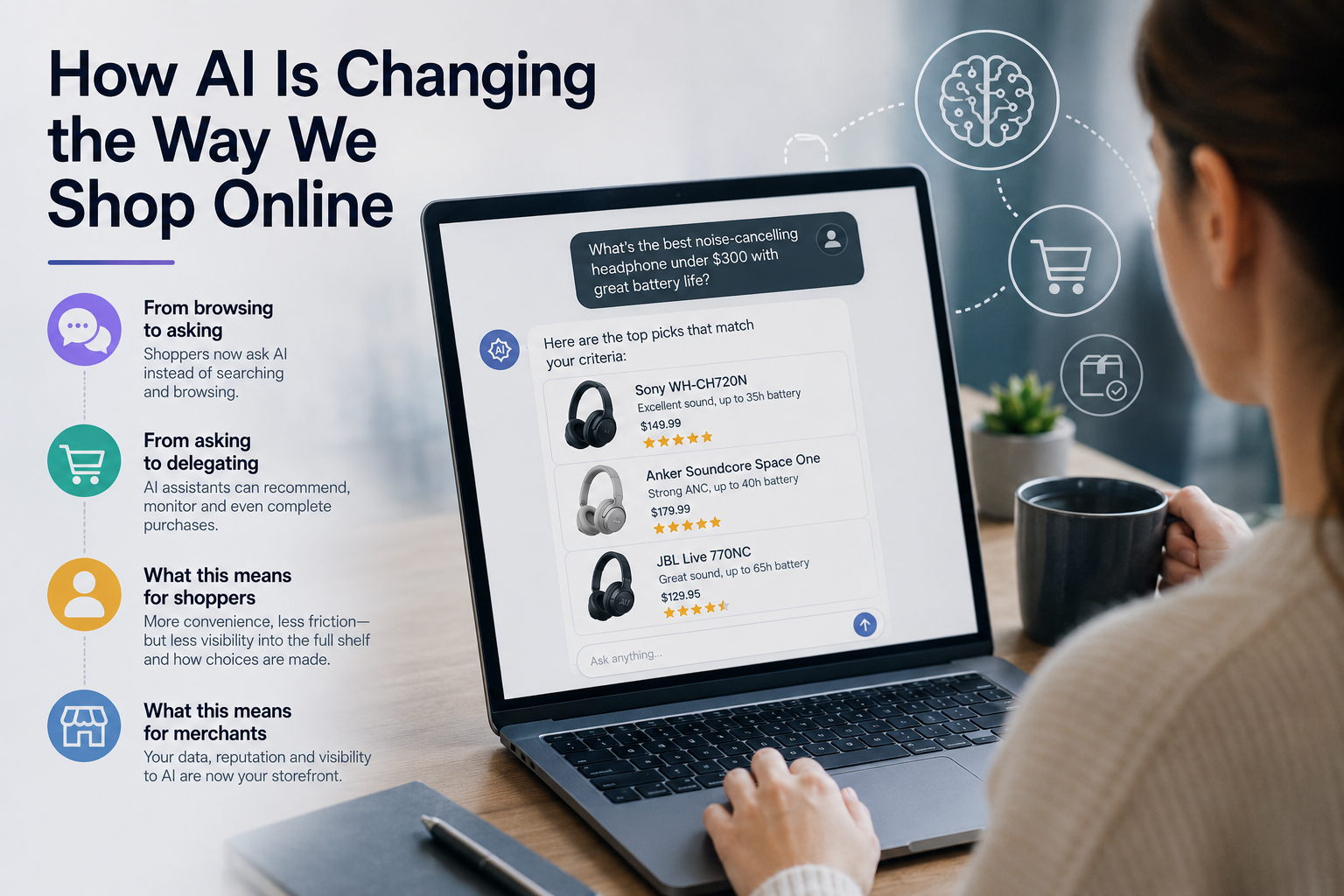
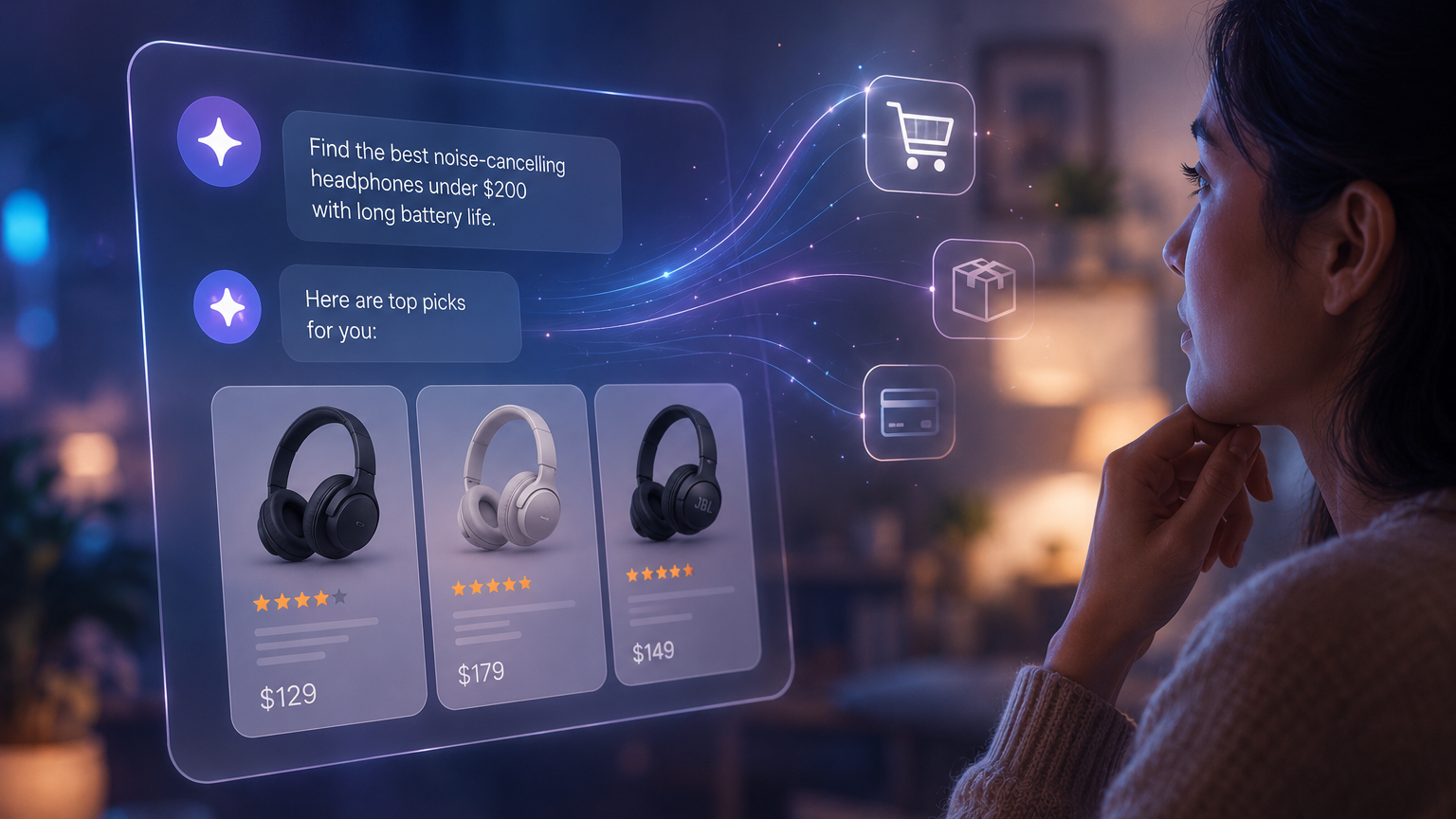
Shopping online used to mean opening a dozen tabs and deciding for yourself. Increasingly it means describing what you want to an assistant and letting it do the deciding. The shelf is starting to be curated by a machine, and that changes things for everyone standing on either side of it.
AI is changing online shopping by moving the work of discovery and decision from the shopper to an assistant. Instead of searching, browsing, and comparing across many sites, a growing number of people now describe what they want to an AI such as ChatGPT, Perplexity, Google's AI Mode, or Amazon's Rufus, and receive a short, synthesized recommendation in return. In some cases the assistant can also complete the purchase. The clearest change so far is in how people find and choose what to buy, while the idea of agents buying entirely on their own is real but still early and uneven.
From browsing to asking
For most of the internet's history, shopping started with a search box or a marketplace, and the shopper did the labor. You typed a query, scanned a page of results, opened a handful of tabs, read reviews, compared prices, and eventually made a choice. The store you landed on was the destination, and a great deal of effort went into getting you there and keeping you there.
That sequence is collapsing into a single exchange. A shopper now asks an assistant something specific, like the best option in a category under a certain price with a particular feature, and the assistant compresses what used to be an afternoon of tabs into a shortlist of a few options with reasons attached. The research, the comparison, and the shortlisting all happen inside one conversation. The store is no longer necessarily the destination. The answer is.
From asking to delegating
Beyond helping people decide, these systems are beginning to act. The ambition across the industry is the autonomous agent that not only recommends but buys, monitoring prices, reordering, and completing checkout on a shopper's behalf once their conditions are met. The infrastructure to support this is being built in the open, through emerging agentic commerce protocols that let an agent transact with a merchant in a structured, machine-readable way.
It is worth being honest about where this actually stands, because the hype has run ahead of the reality. Through early 2026, the most visible attempt at in-chat checkout pulled back after relatively few merchants adopted it and conversion stayed low, and the research consistently shows that shoppers trust a retailer's own assistant far more than a third-party one, with most people still not fully comfortable handing a purchase to an AI. So the picture is lopsided rather than finished. Discovery has genuinely changed. Autonomous buying is coming, but it is arriving slowly, and trust, not technology, is the thing holding it back.
What this means for shoppers
For the person doing the buying, the appeal is obvious and real. The assistant removes an enormous amount of friction, turning a sprawling, noisy process into a quick and reasonably good answer, which is a genuine improvement for the countless purchases nobody enjoys researching.
The cost is subtler and worth understanding. When an assistant hands you three options, you are no longer seeing the full shelf, and you usually cannot see why those three were chosen or what was left out. The curation that used to be visible, a page of results you could scroll and judge, has become a quiet act of selection inside a system whose reasoning you cannot inspect. That puts a great deal of weight on whether the assistant is accurate, whether it is genuinely unbiased, and whether it actually understood what you meant. The convenience is real, but so is the quiet transfer of judgment from the shopper to the model.
What this means for merchants
This is where the change is most profound, and we say that as people who have operated online stores since 2008, through several eras of how customers find things. For a long time the homepage was the front door, and the work of selling online was largely the work of building and optimizing a storefront for human eyes. That assumption is now incomplete. When a meaningful share of customers arrive through an assistant that already compared the options for them, the storefront is no longer where the decision gets made. The decision happens upstream, inside the model, before the customer ever sees your site.
What this means in practice is that your product data, your reviews, your pricing, and your reputation have become your storefront, because those are what the machine reads when it decides whether to recommend you. A business whose catalog is messy, whose information is thin, or whose reputation is illegible to these systems can simply be left out of the recommendation, and unlike a low search ranking, there is often no second page to be found on. This is the practical, buyer-facing edge of the deeper shift we describe in What Is Dynamic Commerce, where commerce becomes infrastructure built to be read by agents as well as people.
There is a harder problem underneath it, too. When a sale originates inside an assistant, much of the usual visibility disappears. A merchant may see that an order arrived from a given agent, but the rich understanding of how the customer got there, what they considered, and whether the sale was incremental, gets thinner. The funnel that businesses spent two decades learning to measure is becoming partly opaque, and getting comfortable operating with less visibility is going to be part of the job.
What stays the same
It would be a mistake to treat all of this as a clean break from everything that came before. Underneath the new interface, the fundamentals of selling are stubbornly unchanged. People still want to trust what they buy. They still care about whether a product is genuinely good, whether the price is fair, and whether the seller has earned a reputation worth relying on. The assistant does not replace any of that. If anything it raises the stakes on it, because a model evaluating you on a customer's behalf is, in its own mechanical way, looking for exactly the same signals of quality and trust a careful human shopper always looked for. The interface is changing quickly. What makes something worth buying is not.
Frequently asked questions
How is AI changing online shopping? AI is shifting the work of finding and choosing products from the shopper to an assistant. People increasingly describe what they want to an AI and receive a short, reasoned shortlist, and in some cases the assistant can complete the purchase, which moves the decision upstream of the store itself.
Can AI assistants actually buy things for me? Some can, through emerging agentic commerce systems, but the capability is still early and uneven. Discovery and comparison are where AI shopping is genuinely strong today, while fully autonomous purchasing is held back less by technology than by shopper trust.
What does AI shopping mean for online stores? It means a store's product data, reviews, pricing, and reputation now function as its storefront, because those are what an AI reads when deciding whether to recommend a business. Stores that are not legible to these systems risk being left out of the recommendation entirely.
Do people trust AI to shop for them? Not fully, yet. Research through early 2026 shows shoppers trust a retailer's own assistant considerably more than third-party assistants, and most people remain cautious about handing over a purchase decision, which is why discovery has changed faster than buying.
What should a business do about AI shopping now? Focus first on being discoverable and accurately represented inside AI answers by making product information clear, complete, and machine-readable, and by maintaining a genuine reputation, since these are the signals an assistant uses when it decides whom to recommend