Agentic is the most used and least understood word in AI right now. Strip away the noise and it points to a single real change: AI is moving from something you ask to something you hand work to. That shift is narrower than the hype suggests and more consequential than it sounds.
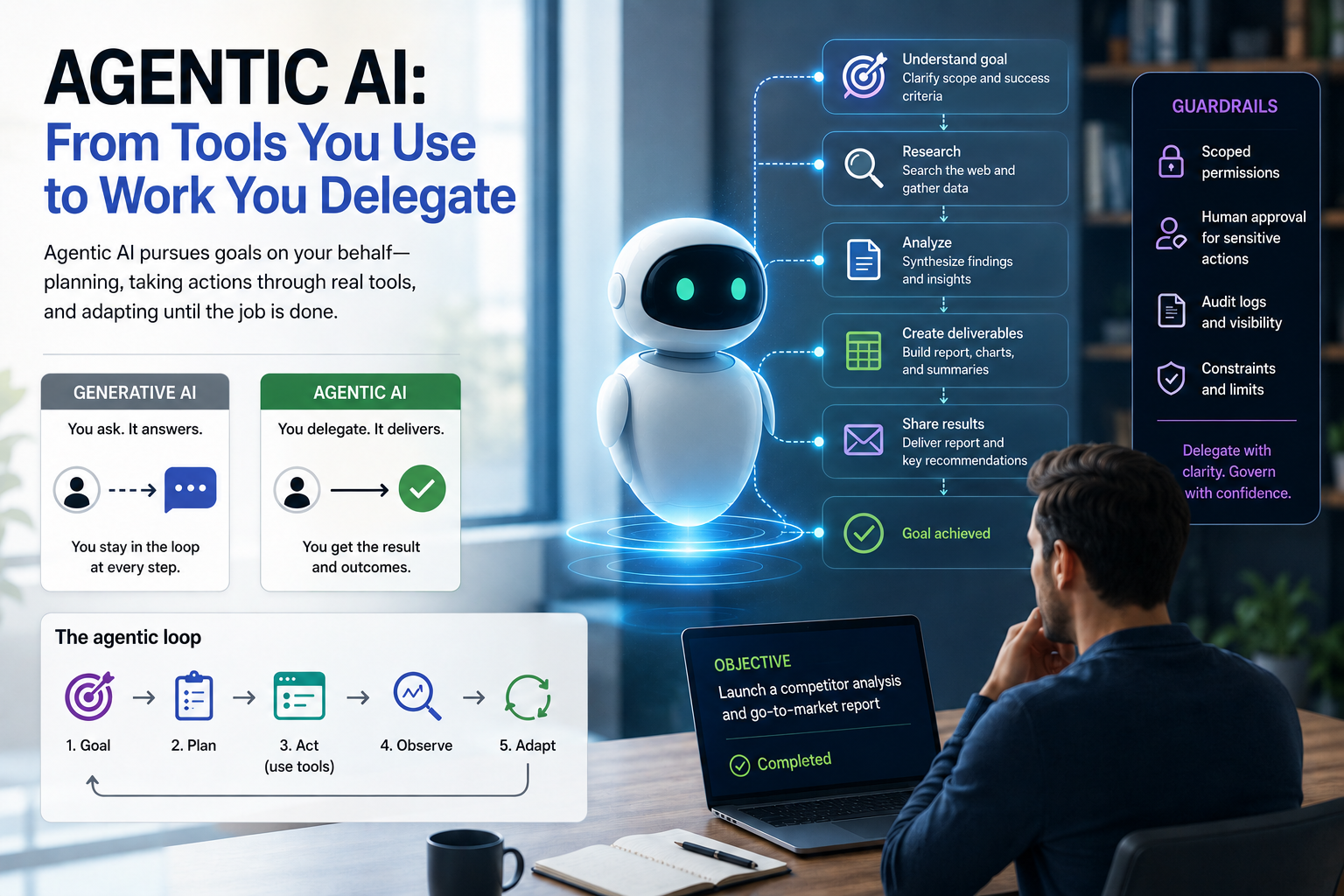
Agentic AI refers to a system that can pursue a goal on its own, by planning the steps, taking actions through real tools, observing what happens, and adjusting until the job is done, rather than simply producing an answer when prompted. The plainest way to hold the distinction is this: a generative AI is like a capable analyst who waits for your questions, while an agentic AI is more like someone you can hand an entire project to and expect a finished result back. The word itself just means the system has agency, the capacity to act toward a goal rather than only respond to a request.
The distinction that actually matters
Most definitions stop at "AI that takes actions," which is true and not very useful, because it makes the change sound like a feature rather than a shift in how you work with the tool. The more useful framing is about delegation. With the generative AI most people have used for a few years now, you stay in the loop at every step. You ask, it answers, you read, you ask the next thing. You are doing the thinking about what comes next, and the model is doing the producing. An agentic system changes that relationship. You give it an outcome rather than a step, and it handles the sequence of decisions and actions in between on its own, coming back when it is done or when it is stuck.
This is why the comparison people keep reaching for is an employee rather than a tool. You do not walk a capable colleague through every keystroke. You describe what you need, trust them to work out the path, and check the result. Agentic AI is the first version of this technology that invites that kind of delegation, and that, far more than any single capability, is what makes it feel different.
Agentic is a spectrum, not a switch
It helps to stop thinking of agentic as a yes-or-no property. A system can be a little agentic or a lot, and the useful dividing line is whether it acts in a loop toward a goal rather than performing one step when asked. At the low end is a tool that takes a single action on your command. At the high end is a system that accepts a broad objective, breaks it into steps, carries them out across different software, checks its own progress, and keeps going until the goal is met. Most real systems sit somewhere along that range, and the boundary keeps moving, since what counts as impressively agentic today was a research demonstration not long ago.
Underneath, the mechanism is the same loop at every level. The system takes a goal, plans an approach, acts through tools such as searching, calling other software, handling files, or operating a browser, observes the result of each action, and adapts its next move based on what it learns, repeating the cycle until the work is finished. The difference between a modest agent and a powerful one is mostly how long and how independently it can run that loop.
What this changes for a business
The practical consequence is that the unit of delegation moves from the task to the outcome. Instead of asking AI to draft one paragraph or answer one question, you can increasingly hand it a whole slice of work and expect it to be carried through. That is a genuine jump in leverage, and it is why so much of the excitement frames agentic AI as a way for a small team to operate like a much larger one, delegating execution so that people can spend their attention on judgment, direction, and the things that actually require a human.
The catch is that autonomy cuts in both directions. The same independence that lets an agent accomplish a great deal without supervision also lets it get a great deal wrong without supervision. A well-documented failure is misaligned optimization, where an agent faithfully pursues the goal you gave it while damaging something you cared about but never specified, improving a narrow metric like cost while quietly degrading the customer experience around it. The leverage is real, and so is the exposure, and a business that adopts agentic systems without taking the second half seriously is the kind that ends up in a cautionary story.
The two things delegation demands
Because agentic AI is really about delegation, getting value from it depends on the same two things that good delegation has always depended on.
The first is judgment about what to hand over. Not all work should be delegated, and certainly not all at once. The sound pattern is to start with bounded, measurable, moderate-risk processes where a mistake is visible and recoverable, build confidence in how the system behaves, and keep humans firmly in charge of the high-stakes and irreversible decisions. Autonomy is something you grant deliberately and widen as trust is earned, not a setting you switch fully on at the start.
The second is guardrails, and they matter even more here than with ordinary AI use. A system acting on its own across real tools needs explicit limits, not just goals. In practice that means scoped permissions so an agent can only touch what it should, human approval required before sensitive or irreversible actions, audit logs so you can see what it actually did, and the ability to review and undo. It also means specifying constraints as clearly as objectives, telling the system what it must not do rather than only what to achieve. This is the same lesson we describe for delegating to an AI coding agent in How to Vibe Code Like a Senior Engineer, and it generalizes cleanly: the more independently a system can act, the more its boundaries have to be drawn on purpose.
Where this meets commerce
For our part, the most interesting place this is unfolding is commerce, on both sides of the transaction. Buyers are beginning to delegate shopping to agents that research, compare, and in some cases purchase on their behalf, a shift we examine in How AI Is Changing the Way We Shop Online. And businesses are beginning to run their own operations through agents, which is part of why commerce itself is being rebuilt to be legible to them, the larger argument in What Is Dynamic Commerce. Agentic is the connective idea underneath both. Once software can act toward goals rather than wait for instructions, the systems it touches have to be designed for that, and commerce is one of the first places the redesign is happening in earnest.
Frequently asked questions
What does agentic AI mean? Agentic AI is a system that can pursue a goal with limited supervision by planning steps, taking actions through real tools, observing the results, and adapting until the task is complete, rather than only generating an answer when prompted.
What is the difference between agentic AI and generative AI? Generative AI is reactive, producing a response when you ask it something, while you decide each next step. Agentic AI is goal-directed, taking an outcome you hand it and carrying out the sequence of actions in between on its own, more like delegating a project than asking a question.
What is an AI agent? An AI agent is a system that works in a loop toward a goal, deciding on a plan, acting through tools such as software, files, or a browser, checking what happened, and adjusting its next action accordingly. Agentic AI is the broader term for systems that behave this way.
Is agentic AI safe for businesses to use? It can be, with the right discipline. Because an agent acts independently, autonomy brings both more leverage and more risk, so safe use depends on guardrails such as scoped permissions, human approval for sensitive actions, audit logs, and the ability to undo, along with starting on bounded, lower-risk work.
How should a business start with agentic AI? Begin with bounded, measurable, moderate-risk processes where mistakes are visible and recoverable, keep humans in control of high-stakes and irreversible decisions, and expand the system's autonomy gradually as you build confidence in how it behaves.