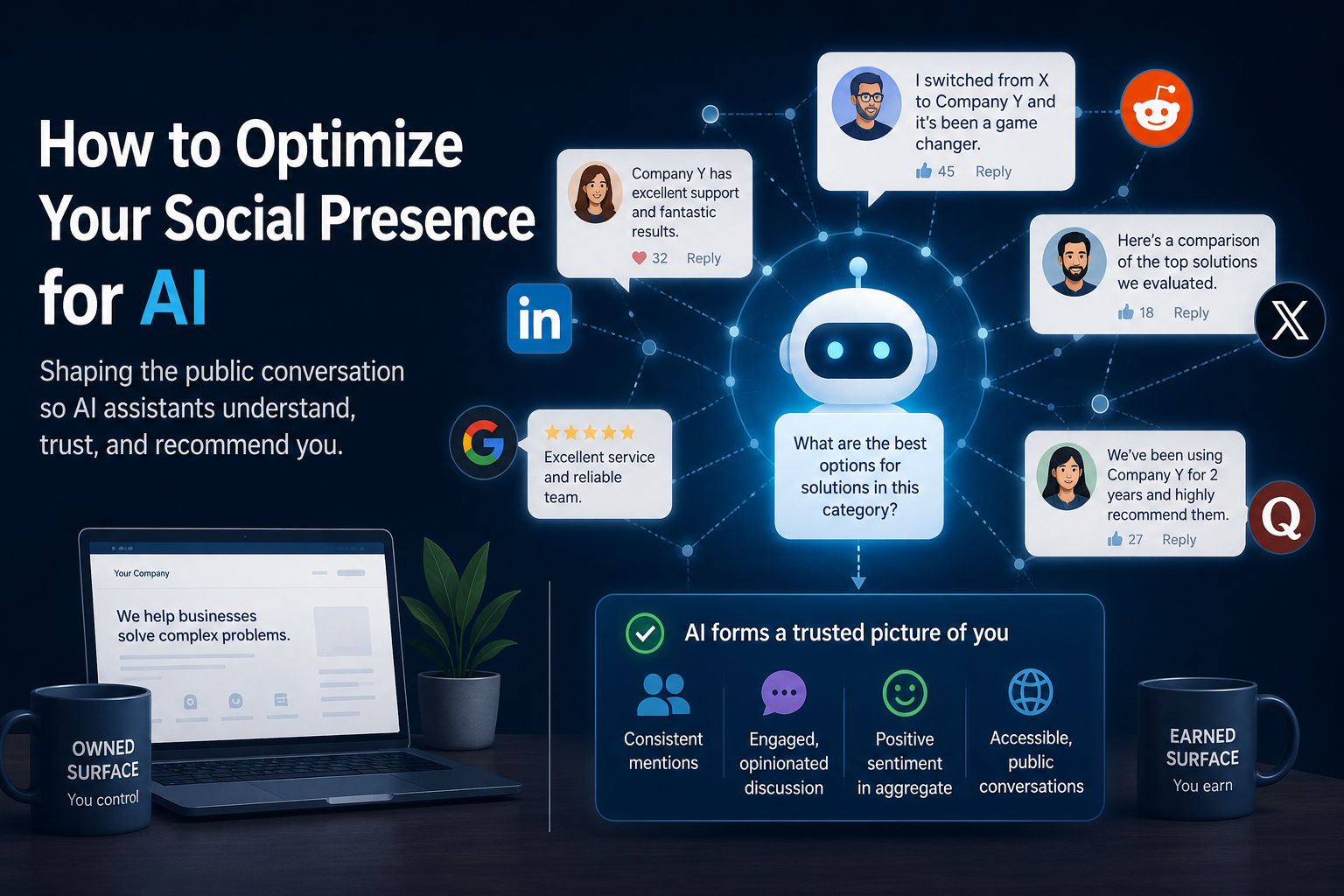

Your website is the surface you own and control. Your social presence is the surface you earn, where other people talk about you and where you take part in public conversation. AI assistants build their picture of who you are from both, and the social half works by rules that surprise most businesses.
Optimizing your social presence for AI means shaping what the public conversation says about you so that AI assistants understand and trust you when they answer questions in your field. The surprising part is where the value actually sits. These systems lean less on your own polished brand posts and more on earned, engaged, opinionated discussion about you, the threads and thoughtful posts where real people compare options and share experiences. So the work is less about broadcasting from your accounts and more about becoming something worth discussing, and participating substantively where that discussion happens.
This is the companion to How to Optimize Your Website for AI Search. That piece covers the surface you own. This one covers the surface you earn, and the two together are how an assistant forms its view of you.
Why social is a different surface
On your website, you control everything, the words, the structure, the claims. Your social presence is different in kind, because most of what matters there is not something you publish but something other people say. An AI assistant reading the social web is not primarily interested in your marketing copy restated on a brand profile. It is interested in the broader signal of how you are talked about, by whom, and with what consistency, because that earned signal is harder to fake and therefore more trustworthy. Understanding that difference is the whole game, because it changes the work from posting more to being discussed well.
What AI actually pulls from social
A few patterns are worth knowing, because they run against the instincts most brands have built up over a decade of social marketing.
The first is that earned beats owned. Research on AI search consistently finds that these systems favor independent, authoritative mentions of you over content you published about yourself, including your own social activity. Your brand account is not where the trust is. The trust is in what others say.
The second is that engaged, opinionated discussion carries the most weight. Assistants draw heavily on platforms built around threaded conversation, because that content is text-heavy, organized, and full of exactly the comparative, evaluative language models extract well, the "I switched from this to that because" kind of post. Discussion forums have become some of the most cited sources in AI answers for this reason, and notably the citations point to the conversations themselves rather than to anyone's brand page. For business-to-business firms, the same dynamic plays out on professional networks, where genuinely substantive posts from real people, often individuals rather than company pages, get pulled into answers because they earned engagement.
The third is that AI reads sentiment in aggregate. These systems are good at detecting the directional pattern across many mentions, what gets consistently praised, what draws repeated complaints, which alternatives keep coming up. Your reputation, in other words, is legible to the machine, not just any single post.
The fourth is that access varies by platform. Some networks built around open, public discussion are readily readable by AI systems, while other large platforms are comparatively walled off. Content that lives where these systems can actually reach it has more chance of shaping an answer than content locked inside a garden they cannot crawl.
What to actually do
Putting that together, a sound approach looks fairly different from a traditional posting calendar.
Start by being consistent about who you are everywhere you appear. The same firm name, the same description of what you do, the same areas of focus, repeated across every profile, helps an assistant assemble an accurate and confident picture of you rather than a fragmented one. This is the same entity-clarity principle that governs your website, applied across the social web.
Then participate substantively where engaged discussion and genuine reach actually live, rather than spreading yourself thin everywhere. That means contributing real expertise to the conversations and communities in your field, in the comparative, experience-driven voice that these systems find and trust, and it means encouraging the knowledgeable people in your organization to post their actual thinking under their own names, since that is what tends to earn the engagement that gets noticed.
Aim to be mentioned, not just to broadcast. The most valuable outcome is other credible people discussing you without being asked, which you earn by being genuinely useful, distinctive, and worth referencing, the same way you earn citations anywhere else.
Tend your reputation deliberately, including reviews on the platforms that matter in your category, because the aggregate sentiment across those sources is a signal the assistant reads directly. And coordinate the whole effort rather than running social in a silo, since AI visibility rewards a consistent, multi-channel presence where your website, your public relations, and your social conversation all tell the same story.
An honest caveat
Two things keep this in proportion. First, social is one input among several, and for many firms it is not even the strongest one, since earned mentions on authoritative third-party sources often outweigh social activity entirely. It is worth doing well, but it is not the whole of being found by AI. Second, this is a fast-moving and partly opaque area. Platforms change what they allow these systems to access, the systems change what they weigh, and any specific tactic should be held loosely. The durable part is the principle underneath: be consistently described, be genuinely discussed, and be substantive where the conversation happens.
How we think about it
This is the daily work of our Digital Identity Division at Esaias and Company, where we treat a firm's presence as something engineered across every surface rather than managed one post at a time. We build the consistency, earn the conversation, and steward the reputation that together make a business legible and trustworthy to the systems increasingly answering questions on its behalf, and we do it knowing the terrain keeps shifting, which is exactly the kind of work we prefer.
Frequently asked questions
Does social media affect what AI says about my business? Yes. AI assistants draw on the social web to understand how a business is discussed, and they weigh that earned conversation, especially engaged, opinionated discussion, when deciding whom to trust and mention in their answers.
Do AI systems prefer my brand posts or what others say about me? Research consistently shows these systems favor earned, third-party mentions over content a brand publishes about itself, including its own social activity. What others say about you carries more trust than what you say about yourself.
Which social platforms matter most for AI visibility? Platforms built around open, threaded, opinionated discussion tend to carry the most weight, because their content is exactly what models extract well, and discussion forums have become some of the most cited sources in AI answers. For business-to-business firms, substantive posts on professional networks matter heavily. Platforms that restrict AI access contribute less, since the systems cannot easily read them.
What is the single most effective social move for AI? Be genuinely discussed rather than simply broadcasting. Earning credible people to reference and discuss you, and participating substantively in the conversations of your field, does more than posting volume from a brand account, because earned and engaged content is what these systems trust.
Is optimizing social for AI different from regular social media marketing? Yes. Traditional social marketing optimizes for human engagement and follower growth, while optimizing for AI focuses on consistent identity, earned mentions, substantive discussion, and aggregate reputation, since those are the signals an assistant uses when it decides how to describe and recommend you.