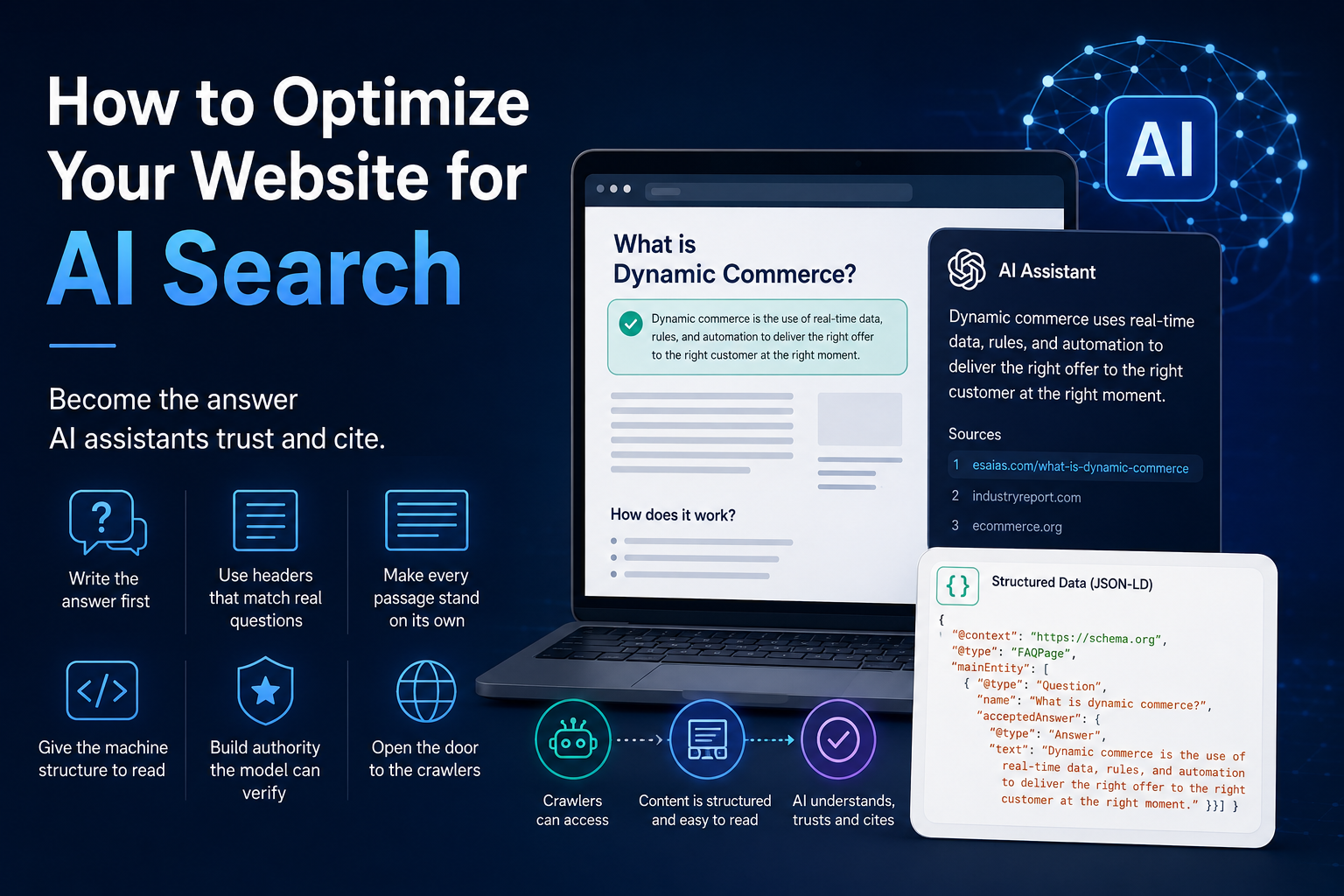

People used to find you by scrolling a results page. Now they ask an assistant, and the assistant answers for them. Optimizing for AI search means becoming the answer it gives.
To optimize your website for AI search, structure your content so a language model can read it, trust it, and quote it accurately. In practice that means writing the direct answer first, using headers that mirror the exact questions people ask, keeping every passage self-contained, marking up your pages with structured data, and building a consistent, authoritative identity across the web. The single highest-leverage move is to state clear, quotable answers to real questions, because that is precisely what an AI extracts when it responds to a user.
This discipline is often called generative engine optimization, or GEO. It is the successor to search engine optimization, and the goals are related but not identical.
How AI search differs from traditional SEO
Traditional SEO was a competition for position. The aim was to rank among ten blue links so a human would choose to click yours. Success was measured in placement and traffic.
AI search removes the list. A person asks a question and receives a single synthesized answer, often with a handful of citations and no scrolling at all. The competition is no longer for a rank. It is for inclusion in the answer itself, and for being named as a source the model trusts.
This changes the work in three ways. Being correct and clear matters more than being clever, because the model rewards extractable substance over persuasion. Being structured matters more than being decorative, because the model reads markup and meaning, not visual design. And being consistent across the web matters more than any single page, because the model builds its sense of who you are from everywhere you appear.
The principles that get you cited
Write the answer first
Lead each page and each section with the direct answer, then explain. Models lift the first clear, complete statement that addresses the query. Burying your answer beneath a narrative introduction hands the citation to a competitor who stated theirs plainly.
Use headers that match real questions
Write headers as the literal questions people ask, such as "What is dynamic commerce?" or "How much does this cost?" rather than clever labels. The closer your header is to the user's actual phrasing, the more likely the model maps your section to their question.
Make every passage stand on its own
Assume a model will read one paragraph in isolation, stripped of everything around it. Each passage should make sense without the sentences before it. Avoid pronouns that point back to earlier context, and restate the subject often enough that any single excerpt is still clear and quotable.
Give the machine structure to read
A page that looks finished to a person can still be illegible to a model. Use clean, semantic markup so the hierarchy of your content is explicit. Add structured data, the schema that labels your pages as an article, an organization, a product, or a list of questions and answers. Include a frequently asked questions section, because the question-and-answer format is the single most extractable structure on the web.
Build authority the model can verify
A model decides whom to trust by looking at how consistently and credibly you appear across the internet. State your identity the same way everywhere: the same firm name, the same description of what you do, the same areas of expertise. Publish original points of view and real data rather than restating what everyone already says, because distinctive, first-hand material is what gets cited. Earn mentions from other reputable sources, since the model treats those as evidence that you are an authority worth quoting.
Open the door to the crawlers
None of this matters if the systems cannot read your site. Make sure your important content is present in the page itself and not hidden behind scripts a crawler cannot execute. Keep pages fast and accessible. Decide deliberately whether to allow the AI crawlers that gather training and answer data, and configure your site to reflect that decision rather than blocking them by accident.
How to measure whether it is working
AI search resists the old dashboards, but it is measurable. Ask the major assistants the questions your customers ask, and note whether you appear in the answer and whether the description of you is accurate. Watch your analytics for referral traffic arriving from AI assistants, a category that now shows up distinctly in most tools. Track how often your firm is named, correctly, when someone asks about your category. Improvement looks like moving from absent, to mentioned, to cited by name.
A discipline, not a trick
The firms that win AI search are not the ones chasing a clever hack. They are the ones whose content is genuinely clear, genuinely authoritative, and genuinely well structured, because that is exactly what these systems are built to surface. The work rewards substance, which is a welcome change.
At Esaias and Company, this is the daily practice of our Digital Identity Division, where we treat a brand's presence as infrastructure rather than decoration. We build the structure, produce the content, and steward the consistency that turn a website into a source an AI trusts. For commerce businesses, this work pairs directly with the shift we describe in What Is Dynamic Commerce, where being legible to agents is no longer optional.
Frequently asked questions
What is AI search optimization? AI search optimization, also called generative engine optimization or GEO, is the practice of structuring a website so that AI assistants can read it, trust it, and quote it accurately when answering a user's question.
How is GEO different from SEO? SEO competes for a rank among links a person chooses to click. GEO competes for inclusion in the single synthesized answer an AI gives, and for being named as a trusted source within it.
What is the most important step to rank in AI search? Write clear, complete, quotable answers to the real questions your audience asks, and place those answers at the top of each page or section, because that is the text an AI extracts when it responds.
Does structured data help with AI search? Yes. Structured data labels your content so a model can identify what each page is, such as an article, an organization, a product, or a set of questions and answers. A frequently asked questions section is especially effective because its format is highly extractable.
How do I know if AI search optimization is working? Ask the major AI assistants the questions your customers ask and check whether you appear and whether the description is accurate, watch for referral traffic from AI assistants in your analytics, and track how often your firm is correctly named in your category.