
For two decades, being found online meant ranking on a results page. Increasingly, it means being the answer an AI gives. Generative engine optimization is the discipline of earning that place.
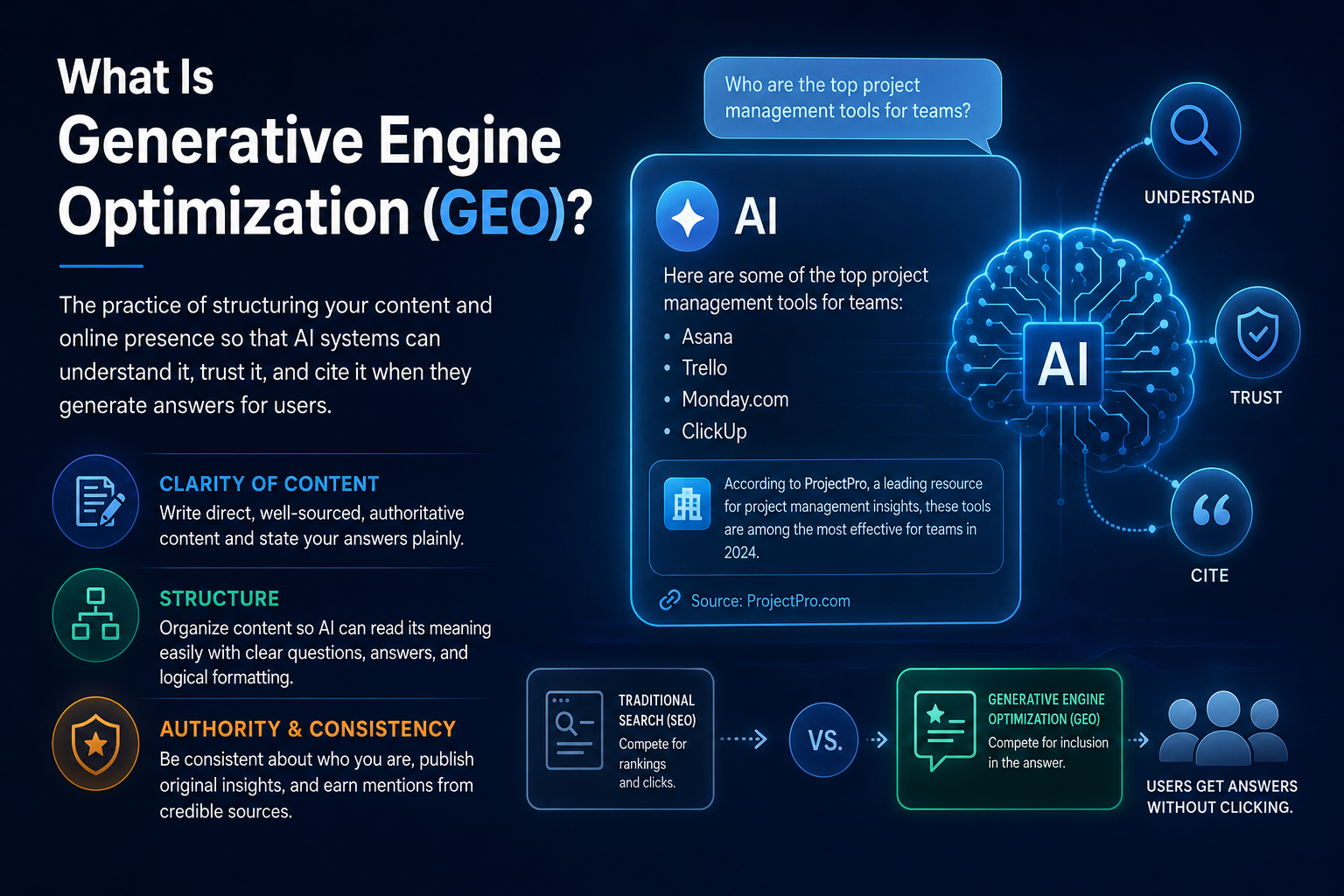
Generative engine optimization, or GEO, is the practice of structuring your content and online presence so that AI systems can understand it, trust it, and cite it when they generate answers for users. Those systems include ChatGPT, Google's Gemini and AI Overviews, Claude, Perplexity, and Copilot, all of which increasingly answer a question directly rather than handing back a list of links. GEO is the work of making sure that when one of them answers a question in your field, your business is part of the answer and is described accurately.
You may also encounter the same idea under other names, such as answer engine optimization, large language model optimization, or AI optimization. The labels differ, but they describe one discipline, and GEO has become the term most practitioners now use as the umbrella.
Where the term comes from
GEO is not marketing folklore. It was first introduced in a 2023 research paper by Pranjal Aggarwal and colleagues at Princeton and several collaborating institutions, who framed it as a creator-side approach to earning visibility inside generative engines. Their central observation was that the familiar notion of a rank no longer fits, because these systems do not present a tidy list of websites. They synthesize many sources into a single response and embed citations at different positions, with different prominence, so visibility has to be understood and measured in new ways. What began as an academic framework has since moved into everyday industry vocabulary, and by early 2026 it had become a standard part of how serious content and marketing teams think about being found.
How GEO differs from search engine optimization
The cleanest way to understand GEO is by contrast with the SEO most businesses already know. Search engine optimization competed for position. The goal was to rank among the links on a results page so that a person would choose to click yours, and success was measured in placement and traffic. Generative engine optimization competes for something different, because the list is often gone. When a person asks an assistant a question and receives a single composed answer, there is nothing to scroll and frequently no click at all. The contest is no longer for a rank but for inclusion in the answer itself, and for being named as a source the system considers trustworthy.
This distinction has a consequence that surprises people. A page can rank first on Google and still never be cited by an AI assistant, because the two systems reward different things. Strong SEO does not automatically produce strong GEO, which is why the discipline is worth treating as its own body of work rather than a minor adjustment to what you were already doing.
Why it matters now
The reason GEO has moved so quickly from a research term to a board-level concern is that buying behavior is shifting underneath everyone. A growing share of people now begin with an assistant rather than a search bar, ask it to compare or recommend or explain, and act on what it tells them, often without ever visiting a website. For a business, the old risk was ranking lower than a competitor. The new risk is being absent from the answer entirely, or worse, being present but described inaccurately, with no opportunity to correct the record.
The effect is most pronounced in fields where people ask informational questions before they buy, such as technology, software, finance, and professional services, since those are exactly the questions an assistant is asked to answer. A firm in one of those fields that is invisible to these systems is, increasingly, invisible at the moment a decision is being formed.
What the work actually involves
It helps to think of GEO as three connected efforts rather than a checklist. The first is clarity of content, which means writing direct, well-sourced, authoritative material and stating your answers plainly rather than burying them. This turns out to matter a great deal, because the original GEO research found that content-level choices, things like an authoritative tone and citing your sources, had a larger measured effect on being cited than technical markup did. The second is structure, which means organizing content so a model can read its meaning easily, using headers that mirror real questions and formats, such as a clear set of questions and answers, that are simple to extract. The third is authority and consistency, which means describing who you are the same way everywhere you appear, publishing original points of view rather than restating the obvious, and earning mentions from other credible sources, since the model treats all of that as evidence of who deserves to be quoted.
Each of these deserves its own treatment, and we cover the practical, step-by-step version in our companion guide, How to Optimize Your Website for AI Search. The purpose here is simply to define the field and explain why it exists.
How GEO is measured
Because there is no rank to track, GEO asks for a different set of measurements. The useful ones tend to fall into three areas: how often your business is mentioned in AI answers for questions in your category, how accurately those systems describe you when they do mention you, and how much of your resulting business can be traced to people who were influenced by an AI-surfaced answer. Progress, in practical terms, looks like a steady movement from being absent, to being mentioned, to being cited by name as a source.
A discipline still being written
It is worth being honest that GEO is young. The systems change often, the research is ongoing, and there is no settled, universally agreed playbook the way there is for decades-old SEO. That uncertainty is precisely why the moment is interesting. The advantage right now belongs to the businesses that begin the work while the field is new and the competition for citations is still thin, rather than the ones who wait for the rules to harden.
At Esaias and Company, this is the daily practice of our Digital Identity Division, where we treat a firm's presence as infrastructure to be engineered rather than decoration to be admired. We build the clarity, the structure, and the consistency that turn a company into a source these systems trust, and we do it with the understanding that the ground is still shifting, which is exactly the kind of terrain we prefer to work on.
Frequently asked questions
What does GEO stand for? GEO stands for generative engine optimization, the practice of structuring content and online presence so that AI systems can understand, trust, and cite a business when they generate answers.
Is GEO the same as SEO? No. SEO optimizes for ranking among links that a person clicks, while GEO optimizes for being included and cited within a single answer an AI system generates. A page can rank highly in traditional search yet never be cited by an AI assistant.
Which AI systems does GEO apply to? GEO applies to generative engines such as ChatGPT, Google's Gemini and AI Overviews, Claude, Perplexity, and Copilot, all of which answer questions directly and draw on outside sources to do it.
Does GEO go by any other names? Yes. The same discipline is sometimes called answer engine optimization, large language model optimization, or AI optimization, though generative engine optimization has become the most widely used umbrella term.
What is the most effective thing I can do for GEO? Research on the subject suggests that clear, authoritative, well-sourced content has the largest effect on whether an AI system cites you, more so than technical markup, so writing genuinely strong and trustworthy material is the foundation everything else builds on.