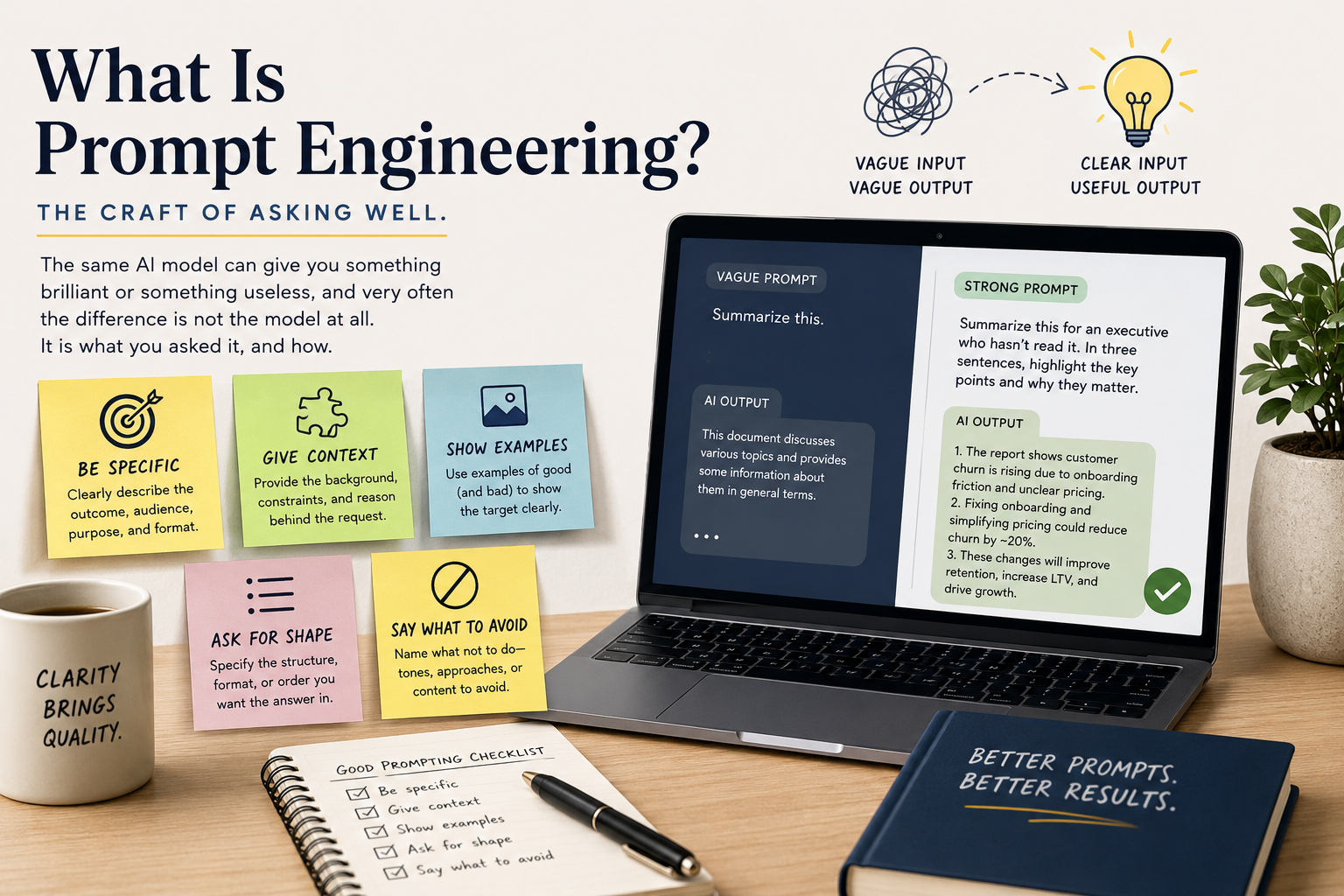

The same AI model can give you something brilliant or something useless, and very often the difference is not the model at all. It is what you asked it, and how. Prompt engineering is the craft of asking well.
Prompt engineering is the practice of writing and refining the instructions you give an AI model so that it produces accurate, useful, and reliable results. At its simplest, it is the craft of communicating your intent clearly enough that the model can actually do what you meant, rather than what your words happened to say. It matters because the quality of what these systems give back is shaped heavily by the quality of what you put in, and the same model can produce wildly different results depending on how the request is framed.
Why prompt engineering exists at all
It would be reasonable to ask why this should be a skill in the first place. If these models are as capable as everyone says, why can they not simply understand what we want? The answer is that they generally do understand language, but they do not share your context, your assumptions, or your sense of what a good result looks like unless you supply it. A model responds to what is actually in front of it. When you give it a vague request, it fills the gaps with the most statistically likely interpretation, which is often not the one you had in mind. Prompt engineering is the work of closing that gap, of making your intent explicit enough that the model's most likely interpretation and your actual goal are the same thing.
This is less mysterious than the name suggests. It is closer to the skill of writing a clear brief for a talented but very literal new colleague who has no memory of your past conversations and no knowledge of your situation beyond what you tell them right now. The clearer the brief, the better the work, and the principles that make a brief good are mostly the principles that make a prompt good.
What good prompting actually involves
Be specific about what you want
Vague requests produce vague results. The more precisely you describe the outcome you are after, including its purpose, its audience, and the form it should take, the more the model can aim at the right target. Asking for a summary gives you something generic. Asking for a three-sentence summary for an executive who has not read the document gives the model an actual goal to hit.
Give it the context it cannot guess
A model knows nothing about your particular situation unless you tell it. Supplying the relevant background, the constraints you are working under, and the reason behind the request lets it reason about your specific case rather than the average case. Most disappointing AI output traces back not to a weak model but to a prompt that withheld the context the model needed to do the job well.
Show it, do not only tell it
One of the most reliable ways to raise quality is to provide an example of what you consider good, or a contrasting pair of a good and a bad version. Examples communicate taste and standards far more efficiently than description does, because they show the model the target instead of trying to explain it in the abstract.
Ask for a particular shape
Telling the model how you want the answer structured, whether that is a short paragraph, a table, a specific format, or a particular order of reasoning, removes a whole category of guesswork. When the shape of the output matters to you, leaving it unspecified means leaving it to chance.
Say what to avoid
Just as useful as describing what you want is naming what you do not want. Telling the model which approaches, tones, or moves to stay away from gives it a boundary to work inside, and it tends to follow such boundaries well when they are stated plainly. This is the same instinct that makes good guardrails matter when you delegate larger tasks to an agent, a subject we go deeper on in How to Vibe Code Like a Senior Engineer.
Is prompt engineering already obsolete?
A fair objection has appeared as the models have improved. If newer systems are increasingly good at inferring what you meant from a casual request, does carefully engineering a prompt still matter, or was it a temporary trick for a temporary limitation?
The honest answer is that part of it was temporary and part of it is durable. The brittle version of prompt engineering, the hunt for magic words and secret phrases that unlocked better behavior, is genuinely fading, because the models no longer need to be coaxed in those ways. But the core of the skill is not a trick at all. It is the ability to think clearly about what you actually want and to communicate that intent and context precisely, and that ability becomes more valuable, not less, as we hand these systems larger and more consequential tasks. A model that can infer a little of your intent still produces far better work when you give it all of your intent. As the work shifts from single questions toward agents carrying out multi-step projects on our behalf, the premium on stating goals, context, and limits clearly only grows.
Why it matters for a business
For any organization adopting these tools, prompt engineering is quietly one of the highest-leverage skills it can build, because it is the difference between AI that produces a stream of mediocre, generic output and AI that produces work worth using. The investment is small and the gap in results is large. This is part of how we think about helping firms put these tools to work at Esaias and Company: the model is rarely the bottleneck, and the returns come from learning to communicate with it well.
Frequently asked questions
What is prompt engineering in simple terms? Prompt engineering is the practice of writing clear, specific instructions for an AI model so that it produces the result you actually want. It is essentially the skill of communicating your intent and context to the model precisely.
Why is prompt engineering important? Because the quality of an AI's output depends heavily on the quality of the input. The same model can produce excellent or useless results from the same task depending on how the request is framed, so learning to frame requests well directly improves what you get.
What makes a good prompt? A good prompt is specific about the desired outcome, supplies the context the model cannot otherwise know, often includes an example of what good looks like, specifies the format of the answer, and states what to avoid. Clarity of intent is the common thread through all of these.
Is prompt engineering still relevant as AI gets better? The search for magic phrases is fading as models improve, but the durable core of the skill, clearly communicating intent, context, and constraints, becomes more valuable as we delegate larger and more complex tasks to AI agents.
Do I need to be technical to do prompt engineering? No. Prompt engineering is fundamentally about clear thinking and clear communication rather than coding. Anyone who can write a precise brief for a capable colleague already has the core ability it depends on.